Showing posts with label Childrens TV. Show all posts

Thursday, March 30, 2017

Juvenilia, Part 2

It was 1984. Return of the Jedi had come out a year ago. 

A disappointed global public had realised that an apparently great cinematic villain was not only such a poor leader that his army could be trounced by a gang of stone age teddy bears but also that – beneath his iconic helmet – he resembled a cross between Humpty Dumpty and a bruised scrotum.

It may seem incredible today, but with no immediate prospects for further Sith work, Darth Vader was reduced to doing PAs for furniture companies at sports centres in west Suffolk.  

And that’s where I met him. True story. There’s his signature to prove it.

"Never cross near parked cars" - that was his other catchphrase
Now, my parents were quick to assure me that this was indeed the “real” Darth Vader – viz. quondam Green Cross Code Man David “Stop, lookand listen” Prowse. Of course, the helmet remaining firmly in place, it could have been anyone tall.

Oh yes, it’s not all exercise books. I have loads of other peculiar fragments of my childhood to show you. 

“Peculiar fragments” being largely all there is. We have always lived far away from our wider family, and in 1987, me, my mum, dad and brother moved away from Bury St Edmunds to Boston in Lincolnshire. I was 11. I wrote letters to my friends, but that fizzled out by 1990 or so.

As a result, my sense of my early life is composed almost entirely of what I remember – without much third party corroboration at all. Where I live now, there are loads of people who have always lived in the area, who have known the friends they see every day since they were babies and whose parents, aunts, uncles, grandparents and so on all live within a mile radius. Their senses of personal history must be pretty well integrated.

That’s not me. I’m not complaining: it is, as they say, what it is. It just means that looking through old stuff I haven’t seen for 30 years or so gives me a very weirdly vertiginous feeling, that the conscious Roger of Sicily is only a part-time tenant of this brain and that the true landlord is somewhere else entirely.  

Enigmatic, eh?

Not as enigmatic as this story about a “family of dwarfs”, who uncovered a plot by spacemen to take over the world – admittedly, while waiting in ambush to murder them with pointed sticks, which takes some of the sheen off their earth-saving heroism.

When the spacemen declare “the time to conquer the world is here”... it ends! 

That’s the last page of the frigging book! 

What was I thinking? I’d give my eight-year-old self a piece of my mind for leaving such a cliffhanger unresolved, if such a thing were even remotely metaphysically possible. 

Tuesday, January 6, 2015

It’s Nerf or Nothing

I’m not a pacifist. I think that violence is the only answer to certain questions. Like the interwar writer and peace campaigner Storm Jameson said about the Nazis, I accept that some things are worth killing for.

But that doesn’t mean that I approve of or like militarism and the glamorisation of violence that we – and especially our kids – seem to be subjected to. Violence is an evil that is occasionally necessary.

As a general rule, Elvira and I have discouraged our boys from having toy guns. Not entirely out of explicit principle – I still remember my boyhood friend in the 1980s who was kicked out of the Woodcraft Folk for drawing a picture of a cannon, which seems to be a matter of putting the cart before the horse – but at least partly because we don’t want them to develop a casual attitude towards the prospect of killing others.

Because that’s what an awful lot of what boys get exposed to through child-oriented media seems to promote. Most of the cartoons that they choose to watch and the video games they choose to play involve fighting of some sort.

Also speaks like a 1930s gangster - WHY?
OK, you expect stuff like that in things like Ben 10 but when the bloody Care Bears are apparently referencing the Vietnam War (or rather films about the Vietnam War) by shouting “fire in the hold” and “incoming!” there’s surely some cultural mutation that’s gone a bit wrong.


Alright, little kids are not likely to get the references (and when did “referencing” things become clever in itself anyway?) but why make the reference to war or war films other than to consciously or unconsciously normalise and make attractive the idea of war?

I grew up as a little militarist through no direct fault of my parents but just by exposure to a pro-violence culture. I thought the Falklands War was the coolest thing ever, primarily because we (Britain) won. In pretty much any scenario, to me and my friends, the baddies were the Germans – despite the Second World War having ended more than 30 years before we were born.

What scientists look like
The hangover from these assumptions are still present today. Watch any cartoon. If there’s a mad or evil scientist in it, he will have a German accent. And he may well be wearing a monocle, which is a cliché that was outdated even by 1939.

Thankfully, we are little more careful today than to casually demonise other races and nationalities to our children. An Afghanistan or Iraq-based version of “Battle Comic” is unimaginable.

Nevertheless, kids are still fed the idea that there is such a thing as cannon-fodder which can be “destroyed” (note the regular use of phrases about “destroying” someone in cartoons as a blatant euphemism for “killing” them) without consequence. It’s just that today it’s robots or aliens or something else non-human that’s been placed outside our moral community, not Japs or Krauts.

To be honest, I think it would do more good to children to show one of these “destroyed” aliens screaming in pain, shitting itself and crying out for its mother than sanitising death to the point where they’re indifferent to it. But instead, we just see the fallen body flash and then disappear – if we even think about it at all. This indifference was parodied to great effect in the first Austin Powers movie, where we saw the henchman’s wife finding out he’d been killed.  

This all brings me on to Nerf guns. Our kids got some of these for Xmas. I wish they hadn’t. Now, if the people who got them are reading this – in no way am I having a go at you about this. Guns are appropriate and popular presents for boys. That’s just the world we live in, whether we like it or not. They were always going to end up with toy guns, it was just a matter of when. The kids loved them and I’m not going to deny that even I enjoyed playing with them.

It looked like this
I had toy guns when I was a young ‘un, ranging from cowboy revolvers to replica M16s. I particularly remember my own Mauser automatic pistol – which, being German, was inherently an evil weapon.

Apart from spud guns though, I don’t think they fired anything. Nerf guns fire sponge darts with a soft plastic tip. They use what appears to be the same mechanism as used by air guns (I stand to be corrected if that’s wrong – it’s not like I do any research here...). They propel those darts with a surprising amount of force. If you got shot with one, it would sting a bit.

Now I’m sure Nerf and other “airsoft” stuff is safe enough to comply with legal standards and that you’d really have to be doing something stupid in order to have somebody’s eye out with one. You can certainly throw a ball, or a toy car, or a rocking horse at someone’s head and do them just as much if not more harm as you can by shooting them with a Nerf gun.

But have you seen the adverts for Nerf stuff? They feature paramilitarised American teenagers – old enough to impress kiddies and young enough to frighten the grown-ups – romping around, Call of Duty-style, discharging blasts from their rapid-fire, multi-barrelled plastic guns, and then proclaiming in a voice laced with menace that “it’s Nerf or nothing”.

If this was taking place in real life, they would – of course – be shooting at each other, or unwilling nerds. But that can’t be shown on TV. And nobody is likely to get very excited about shooting tin cans any more.

So do you know how they’ve got round that problem? Bloody zombies.


Yes, Nerf “zombie strike” weapons are for shooting zombies: kids today’s Germans.

Zombies offer the advantage of having the precise same anatomy as a human being whilst it is nevertheless unambiguously ok to shoot them because they’re evil or because it’s self-defence or something. This is a Nerf machete. Only for killing zombies, obviously.
In no way does this desensitive kids to violence...

And so Nerf takes us over the line from cartoon violence into real world violence where we go around pointing guns at human-shaped objects that we understand to be incapable of suffering and/or deserving of death. And when we pull the trigger, we don’t just get a feeble “rat a tat” noise like we used to – we launch something that behaves very much like a bullet. 

Friday, September 26, 2014

Frozen Apart

I listened to Emma Watson’s speech to the UN about gender equality earlier this week, after having been made to watch Frozen on two consecutive days by my two sons.

Now, we went to the cinema to see Frozen – and my response at the end was to compare it to a Barbie movie. You know, the kind they show on Nick Jr.

It was a throwaway comment from a throwaway thought. I thought it was a bit girly.
But why did I think that? Because the main characters are female?

Both of our boys have been through a brief phase of strong aversion to “geeee-uurrrrls” and anything associated with them, but they now seem comfortable with them. Possibly because anything that is “for babies” is the current anathema.

Roger Jr and Tancred love Frozen and are seemingly oblivious to the gender of characters and their positions and roles with respect to one another. Roger Jr doesn’t like me belting out “Let it go” but that is probably because I only know three lines, and repeat them over and over again. 

I’d like them to stay oblivious. But will they? Can their innocence or lack of prejudice stand up to social conditioning?

The white one lays eggs, so must be a girl
Both kids love Angry Birds too. Apart from the birds’ often heavy eyebrows, I can’t see any evidence to suggest that they are all male. So why did Rovio feel the need to release Angry Birds Stella or – as it really ought to be called “Angry Birds For Girls”?

We thought the Lego Movie was great (I preferred it to Frozen). Lego has never seemed “gendered” to me. So why do we now have Lego Friends – or as it ought to be called “Lego For Girls”?

I don’t want my boys to grow up thinking that girls are aliens. Attitudes laid down in early childhood colour everything you come to think subsequently. Reinforcing the exclusivity of gender through toys and culture are the first step on the train towards not being able to speak to women as a teenager and beyond, terminating at the sort of hopelessly fucked-up attitudes displayed by the people who threatened to release naked pictures of Emma Watson for speaking out.

I’m a white, middle-aged, heterosexual man who is a father of two boys. The most valuable contribution I can make to feminism, I reckon, is to try and make sure my sons are kept off the kind of path that leads to being unable to comprehend, to fearing or to hating half the population (the more interesting half, I might add...).

Internet trolls and other species of arsehole are not created overnight. It takes a human being a long time of holding and being reinforced in deeply mistaken and unpleasant views to get to the point where they make rape threats on Twitter.

Everyone has their part to play, but parents – especially fathers of boys – have to do more to stop forcing kids to see the world in terms of gender “us” and gender “them”.

This isn’t something I think constantly about, but when I do I realise that I feel quite strongly about it. 

Now, if you’ll excuse me, I have to go and watch Frozen for the third time this week. Have a watch of this yourself if you haven't already. Then let it go...


Friday, July 26, 2013

Sticky Buds

My childhood will look very little like the childhood my children have. I spent most of the summer holidays wandering around with a pack of other feral youngsters, roaming a specified radius but essentially unsupervised and returning only to be fed or when darkness fell, whichever came sooner.

Children’s TV was broadcast for only an hour or so a day. If you had said “handheld games console” we would have pictured something along the lines of Frogger, powered by 8 non-rechargeable D-batteries or an AC adapter with about 3 inches of cable.

Yes, kids today blah blah blah. Ain’t it awful?

But one thing has not changed, and that is the delight and horror children can extract from the mundane flora of the United Kingdom.

I have been introducing my boys (Roger Jr and Tancred) to one of my favourite leisure plants, and nothing has made me more proud as a father than to see them getting as much enjoyment out of it as I ever did.

I speak, of course, of the sticky bud – Galium aparine, also known (I discovered literally today) as goosegrass.

What a plant! You can throw it at people – and it sticks to them!
An unpopular child's fate

Seriously, in the early 1980s in Suffolk this is what passed for fun: chasing one another around wood and scrubland wielding bundles of creeper. Losers would quickly be made to resemble a green man.


That was really its only application. It was passed down from generations of schoolboy lore than stored and dried for long enough, sticky buds would turn into the legendary stinkweed – however, no one I knew ever achieved the alchemical Great Work.

Yes, I have introduced my children to sticky buds and now happily feel the lash of barbed plant matter on the back of my neck every time we take the dogs for a walk, and merrily pick burs off washed clothing with a wry smile upon my face.

I do, however, think it is important to teach my offspring about right and wrong. And so, having shown them all that is good in the vegetable kingdom, I have also warned them about the natural enemy of the toddler – the nettle.

I remember nettle stings hurting a lot more when I was a young ‘un. Judging from Roger Jr and Tancred’s reaction to even the most evanescent contact with them, this is down to my advancing enleatherment rather than nettles having become less malicious.

Plant morality in action
In the woods near my house, the age old battle between good and evil is being fought out once again. A stand of nettles, towering a good five feet high, has been flattened – not by vengeful stick-wielding infants – but by sticky buds, creeping and climbing all over it. 

Much like the Nazi war machine in the immediate aftermath of the Battle of Stalingrad, the nettles crumpled back to the ground, with only a few isolated pockets of resistance holding out.

But what’s this? A plant not of my childhood has intervened and is pursuing its own, unknown agenda. Bindweed.  Nettles may be evil, but there is at least a straightforwardness and a nobility in their evil. The old certainties are being pushed aside, as bindweed spreads its insidious tentacles around the grappling combatants.

A metaphor
Where did it come from? What does it want? We simply don’t know – it’s alien, it frightens us. It doesn't sting but you can't chuck a load of it on someone's back either without them realising either. And it keeps on coming. 


And that is how the place where I take my dogs to the toilet provides a metaphor for the times we live in today. 

Thursday, February 21, 2013

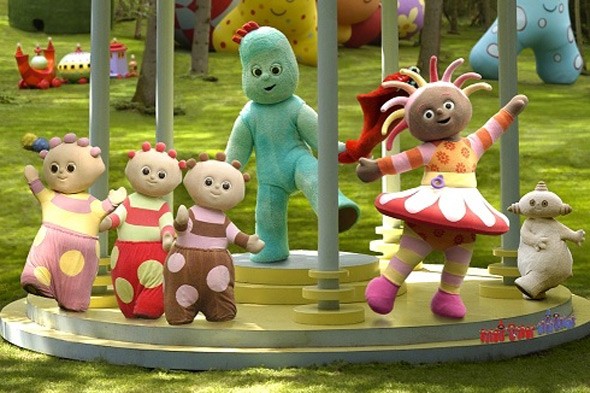
In the Night Garden of the Soul


If you are not a parent, you are unlikely to have watched even more than a couple of minutes of “In the Night Garden” – if you are even aware of its existence.

If you are, you may – as I have – sat through hours of seemingly identical episodes of this bizarre and yet (for toddlers) utterly compelling programme.

Over the years, advertisers and even programme-makers have every so often proclaimed that they have produced some sort of televisual material “for dogs”, “for cats” etc.

Supposedly, these offerings have been based on research into how the minds of pets work, so that they will appeal to them.

Quite why anyone would want to create television that appeals to creatures that (i) do not have any money to spend on goods and service advertised and (ii) have better things to do than watch TV, such as sniffing the ground or licking their testicles, is unclear.

And yet it was nevertheless done, no doubt bringing to bear the kind of “science” that makes shampoo capable of increasing hair shine by 80% and inventing Bifidus Digestivum.

Over the years, I have watched some of these programmes “for animals” and my overriding memory of them was “what the hell was that all about?” – much as I expect the reaction of most dogs and cats to have been.

The argument as to why it made no sense to me, I suppose, would have been that these things were designed to stimulate the brains of animals, which in cognitive and (presumably) phenomenological terms are very different from mine.

That then, I suppose, explains the complete incomprehensibility of “In the Night Garden” to anyone older than three and its narcotic, addictive effect on toddlers. It has been carefully designed to interface with the brains of the undeveloped in a way that leaves the adult confused, bored and liable to drift off themselves into flights of WTF? fancy.

Which is what you are about to get right now, after I watched an entire episode of this with Tancred at the weekend.

Perhaps the Night Garden is in US
It occurred to me at the outset that ITNG features a lot of Freudian motifs.

First of all – the whole thing is a dream. Each episode starts with IgglePiggle going to sleep. The Night Garden is not a place; it’s a dream state.
Take the little sail down 
Light the little light
This is the way to the garden in the night
The “way” is the method of the dreamer, a psychical roadmap not a geographical one. It is only by taking his sail down – by ceasing to resist and to strive – that IgglePiggle can approach the Night Garden.

IgglePiggle then is a figure of tragic proportions. In reality, he is:
Out on the ocean 
Far away from land
He has – like Borges in “The Circular Ruins” – dreamed himself a whole new existence. No wonder he doesn't want to go to sleep at the end - to sleep in the dream world is to return to the utter isolation of the sea. 

The three central characters – or archetypes – correspond to Freud’s tripartite division of the mind: 
  • IgglePiggle is manifestly the Ego at the centre of consciousness.
  • Upsy Daisy is the Id – her phallic, erectile hair; her skirt which pops up wantonly at the pull of a string; her wandering bed which “only Upsy Daisy is allowed to sleep in”; and her overwhelming desire to kiss everyone are surely proof enough that she represents a raging whirlwind of sexuality and unconscious desire.
  • MakkaPakka, by contrast, with his stooped, gnomelike body and obsession with “cleaning the faces” of the other characters is clearly the Superego – the force of repression, conscience and self-control.
The Ninky Nonk, moreover, is clearly Thanatos or the death instinct. Every journey on the Ninky Nonk ends up as a terrifying hellride which all are lucky to survive and yet the characters KEEP GOING BACK ON IT.

"An unconscious sense of guilt"
At this point, my analysis begins to break down. The opposite force to the Ninky Nonk is – as everyone knows – the Pinky Ponk, which ought then to represent the life instinct or Eros. The only way I can give any justification to that theory by pointing out that it looks like a big, green, flying tit.

Eventually, one’s knowledge of a subject matter and willingness to stretch an already ridiculously overtaxed metaphor becomes exhausted and the maddeningly disorienting power of the programme drives one’s thoughts along a new track.

Tombliboos are clearly the immature form of Teletubbies. The Tombliboo larvae and hatch out after a couple of weeks as adult Teletubbies – at which point, they are carefully relocated from the night garden to Teletubbie land.

Terrifying, bloody slaughter
The principal predators in the Tombliboo ecosystem are Fimbles. A hungry Fimble that breaks into a Tombliboo bush: a bloodthirsty tornado of fang and claw ensues, which – trousers or no trousers – the Tombliboos are helpless to resist. It is one of nature’s most shocking scenes, which has yet to have been captured on film.

As you can see, it is bewildering for an adult human to watch an entire episode of “In the Night Garden”. I haven’t even touched on the Pontypines and the myriad potential meanings of “wave to the Wottingers”. Is Mr Pontypine’s detachable moustache an emblem of castration-anxiety? And what are the Tittifers really?

Beware the Night Garden – once you have been there, you may come back a different person altogether. 

Wednesday, September 14, 2011

I can't handle the truth


So, Blogger has a new interface which includes something resembling a child's version of Google Analytics.

Oh, I know I said I was never going to talk about SEO on here, but this is too interesting – by which I mean disheartening – to ignore.

Turns out round about one third of the traffic that has EVER come here has come in from people looking for pictures of Peppa Pig.

Back in March, I wrote a post about said pig, which was well-received and even got randomly linked to from a site promoting "real breast feeding" or something.

Ever since, I have been thinking that if I really want to give up work and write this nonsense for a living, I was going to have to sit and analyse a lot more episodes of Peppa Pig and think of something amusing to say about them. I've got quite a long way with this project so far and – even in the light of this setback - may well return to it in future.

Anyway, the goddam new interface has shown me (from a list of top URLs for incoming traffic) that it's not my ingenious interpretation of the Mummy Rabbit/Miss Rabbit dichotomy that has drawn in the readers. No, it's the fact that Google Images indexed the bloody picture.

So...LOOK! IT'S GEORGE! DINE-SAW!!!!!! LOOK AT MEEEEEEE!!!!!!