Showing posts with label German language. Show all posts

Thursday, June 2, 2016

Whoever Wins We Lose

That was the strapline for 2004’s “AVP: Alien vs Predator” - a showdown between two hideous, misanthropic powers in which ordinary people like you and I feature only as collateral damage. Does that sound familiar?

Yes, it's another post about the EU referendum. 

Given the choice between having a living embryo implanted in me which would eventually gnaw its way out of my chest and being hunted for sport, I would probably have to come down in support of the Predator.

But when it comes to voting for Brexit or Bremain, it’s not quite such a clear-cut choice. Our ballot papers arrived yesterday and - having just last week urged all of you to vote FOR something rather than AGAINST - I don’t know what I’m going to do. Brabstention is not an option, but Brapathy and Brisgust are exerting a lot of Brinertia on me.

Why it’s hard to vote Brexit
At the risk of offending my bien-pensant friends who suffer no such atavistic urges, there’s a part of me that wants to vote Brexit. It’s roughly the same part that made me an insufferable teenage wannabe Marxist windbag, an insufferable “punker than thou” music snob and various other species of insufferable arse over the years.

It’s that “anti” attitude which makes one’s default position one of opposition to/distaste for whatever exists in favour of an alternative that doesn’t. 

“Some men just want to watch the world burn”, said butler Alfred in The Dark Knight (a film about a man who dresses up as a bat to fight a man who dresses up as a clown). I’m not sure if that’s quite Roger of Sicily, but I certainly am one of those people who is attracted by a desire to see the look on a lot of people’s faces the day after a “Leave” vote.

But then I think about Boris Johnson’s face and Nigel Farage’s face… And I think, as much as I would like to treat “the issues” completely separately from “the personalities”, it’s these awful people who would be the power in the land come June 23rd.

And as well as believing in leaving the EU (debatable in Boris Johnson’s case), most of these people also hold a lot of other opinions I strongly disagree with. Intellectual, libertarian Brexiteers like Douglas Carswell have disappeared, so that voting in favour of leaving the EU cannot be separated from voting in favour of a whole lot of nativist, racist, social-authoritarian, revanchist “back to the Empire” idiocy. 

We do not have the option of voting for one without voting for the other. Some people are happy with that, but I’m not.
The downside of the Singaporean model

A case could be made for a post-EU Britain reviving itself economically and culturally once the dead hand of Brussels was cast off - although the only version I’ve seen to date is a suggestion that we follow the example of Lee Kuan Yew’s Singapore, which is hardly a great model for liberals and democrats.

However, the forces that would take power in the event of a Brexit vote have no idea of how they would achieve that. If they do, they’re keeping it quiet, because I can only assume that it would be to subject the UK to the sort of neo-Thatcherite deregulatory shock therapy the former Eastern Bloc underwent after 1989.

The Brexit camps encompass a lot of different positions, but it’s the entitled, right wing, economic know-nothings who would be in power in Brexit wins. That’s the problem. And that's why I have trouble voting for them.

Why it’s hard to vote Bremain
“I'll forgive and forget, If you say you'll never go. 'Cos its true what they say - It's better the devil you know” said Kylie Miongue in her 1990 number 2 hit, “Better The Devil You Know”.

If taken literally, that is surely one of the most pessimistic and retrograde messages ever committed to CD, vinyl and cassette. Yet it is the sum total of the Remain camp’s argument: everything will be worse if you seek change. You are powerless to improve your lot in life, so surrender to your fate.

Thanks a lot Kylie.

Let me make one thing clear: I love the many different cultures and peoples of Europe. I feel a shared sense of pride in our cultural and economic achievements and a shared sense of shame and humility in the face of our crimes and tragedies. It’s obvious that in a globalised world, some things are better done at a supranational level. I love the German language, French wine, Spanish holidays, Scandinavian crime dramas, Greek philosophy, Balkan brass bands, full English breakfasts, Italian coffee, Slovenian avant-garde industrial music, Swiss AND Belgian chocolate and more. I think I am as far from a Little Englander as it’s possible to be. A real union of Europe would be a magnificent thing. 

But the European Union we actually have is a rotten, corporatist, undemocratic mess. Surely the negativity of the Remain campaign reflects the fact that when you consider the EU on its own merits - as opposed to the spirit it is intended to (but does not) embody or the merits of others it ascribes to itself (eg lack of European war) - it's pretty hard to get enthusiastic about. 

Within the EU, the idea that every political problem has a technocratic solution has metastatized into a self-congratulatory, anti-pluralist “because we say so”, embodied in Jean-Claude Juncker’s warning that “deserters will not be welcomed back” in the event of a Brexit vote.

If the technocrats were competent you might have more sympathy, but they’re not. The story of Greece is just the most glaring example - allowed into the Euro on data everyone knew was false to prove a political point, now reduced to penury for the sake of international bondholders. And that’s what happens to non-deserters...

Europe will continue to exist and Britain will continue to be a part of Europe whether the UK is in the EU or not. Whether the EU survives much longer with or without the UK is another question entirely. 

So endorsing our continued participation in this arrogant shambles is something I find it hard to put my vote towards. 
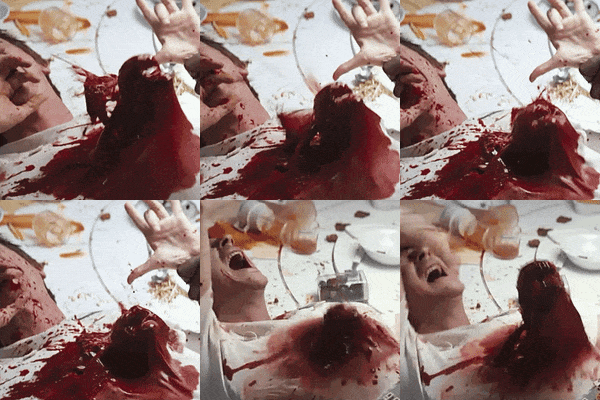
foxhomeent  alien ridley scott chestbursterThere you have it: that’s my dilemma. If I follow my own advice and vote FOR one side rather than AGAINST the other, I am unavoidably voting FOR something I find repulsive. 

Not as repulsive as John Hurt’s gruesome demise in Alien, but not far off. 

Monday, May 19, 2014

Good Grammar? No Thing Cost!

I went to an English grammar school, but I don’t remember learning any English grammar while I was there.

Similarly, I have GCSEs in English Language and English Literature, but I don’t recall ever being really explicitly taught anything about the former. Just a lot of the latter.

I also did GCSE Latin, which is pretty much the only reason I know anything about grammar today. In retrospect, the modern languages we did at school covered a lot of grammar, but at the time I don’t think anyone really appreciated that that's what it was.

Now, before anyone loses their shit at me for despoiling their childhood, I’m not saying this is good or bad or even that this is what actually happened. This is just how I remember it 20+ years on.

What I am saying is that, on the internet these days, there seems to be a thing called being a “grammar snob” or even a “grammar Nazi” – which consists of sneering at other people’s ungainly efforts to express themselves, presumably from a position of knowing the “right” way to do it.  Or complaining about people who do that. Whatevs.

And I find this strange, because I find myself having – at best – an instinctive sense of what English grammar is and not an explicit understanding. I’m fairly well educated and I’ve made a living out of online content (not THIS! My real job!) for some years now. So I ought to know more than most, right?

I have found that it is only my vestigial knowledge of Latin (why does the stuff you learn at school stick around? “Then, first, before the rest and with a great accompanying crowd, Laocoon came blazing down from the citadel...”) and my subsequent attempts to learn German that have taught me what auxiliary verbs are and what “subjunctive” means. No English teacher ever did.

How many self-proclaimed grammar snobs can tell a gerund from a gerundive? I can’t. And how many of the tiny percentage who can say yes can only do so because they learned a different language?

Now, I don’t believe for one second that I have ever been unable to communicate with a fellow English speaker because of a lack of formal grammatical training. I suspect that one of the good things about this language is its openness to innovation (errors, if you prefer, snobs) and its flexibility.

Grammar snobs can piss off, telling people they are using language wrong. No - if you think language is a delicate flower that needs to be protected from use then you're wrong. The nail got knocked in whether you did it with a wrench or a hammer. When it comes to our own language (not your own), communication is what matters. 

But might our national problem with learning other languages not be ameliorated a little if all that conjugation and declension bollocks we got forcefed was treated as something we are already coping with just fine every time we speak or write? Something that is not completely new and alien, but just another way of doing something we’re doing all the time?

I certainly don’t want to be called a grammar snob, but a little grammar would surely help a lot.

Comments welcome below. First person who works in education to make a snidely predictable remark about Michael Gove wins a commemorative tea towel. 

Friday, April 19, 2013

A constructive use of time – learning German, pt 5


It has been 17 months since I last posted on this subject, which perhaps gives you a sense of how thoroughly I have been pursuing this particular personal goal.

Well, let me tell you how I have been getting on in the meantime:
  1. Since my iPod packed up, I have transferred all my Michel Thomas German CDs onto my iPhone. I haven’t listened to any of them yet. By the way, Amazon are offering me £15.90 to trade the course in – and yet, I have it all in electronic form now! HA HA HA.
  2. While we were in Barcelona last weekend, Elvira and I went to see Rammstein...who are German.

One of the problems I always experienced with language learning at school was that learning to read and write something is in no way a guarantee – or even particularly helpful – in learning to understand what someone is saying to you.

That made the marks I achieved in different exams somewhat erratic: explaining the C I got in AS Level French – back when that was a proper exam, not just a certificate for getting through the first half of sixth form - as the outcome of my inability to do French listening with any degree of accuracy.

So I have been honing my German listening skills by playing a lot of Rammstein. This has expanded my vocabulary into many areas left out of the pre-GCSE syllabus, like cannibalism. 

As a parent, one has to be careful about the rock music one exposes one’s kids to. I was horrified to hear Tancred sing back some Turbonegro lyrics to me after I had been carelessly murmuring them to myself.

But Rammstein have the advantage of singing in German – so that with a handful of exceptions, one can relax about the lyrical content: my kids are ENGLISH! They will NEVER speak a foreign language properly! And it is frankly hilarious to hear 2 and 4 year olds impersonating Till Lindemann booming “Amerika ist Wunderbar”.


Anyway, on to the gig review.
  • Rammstein live – Awesome. Especially the keyboard player’s treadmill. I was transfixed.
  • Rammstein’s audience – Old and very respectable. Lots of neatly tucked in tour t-shirts (which, I might add were priced from a minimum of 25 euros). Somehow, we ended up with tickets in a section that had been sold exclusively to middle aged Germans. The thoroughness of their jaunty familiarity with Rammstein’s more gruesome lyrics was disturbingly at odds with their general appearance.  
  • Palau St Jordi – Great concert venue. It’s got balconies you can get outdoors on. Ample toilet facilities (although not as ample as La Sagrada Familia). Weirdly, the seat numbers on our row went 13, 15, 14, 16 – this was a relief as for three months I had been a little anxious about having asked for seats together but in fact getting tickets for seats 13 and 15. In the end though, I was just relieved they were real. 


Thursday, June 21, 2012

Architecture and Morality


I have been wandering around Leeds city centre at lunchtimes since the start of the year.

Given that one can only get so far and still have enough time to get back to the office, as you can probably imagine, the novelty soon wore off.

However, seeing as I am doing it for exercise – having cancelled my gym membership at the end of the year – I have been persevering with it, while trying to find new ways of making it interesting.

First off, I am listening to my Michel Thomas German language course a lot. All I need to take this to the next level (as we say whilst inwardly dying in management meetings) is find someone else who wants to speak German and start speaking to them. In German.

Right now, all I’m doing is walking about whispering to myself – which is, of course, the international language of the mental patient.

Secondly, I am looking up.

Most of the people shuffling around the city streets rarely raise they eyes above the level of the shop-fronts. I, however, have been looking at the uppermost parts of Leeds’ buildings and I’ve reached two conclusions:

1. There is a hell of a lot of vacant commercial property in the city centre - so if you need business premises, you should be able to get a very good deal.

2. If you flooded or buried Leeds to a depth of about 15 feet, you'd actually be left with quite a beautiful place.

There are some really fascinating buildings around which you would never give a second glance to because of the staggeringly banal contents of their ground floors. The most extreme example of former "oooh" and present "meh" surely has to be the one-time Jubilee Hotel on The Headrow – now the "Red Leopard" lapdancing establishment.

My personal favourite is St Paul’s House in Park Square (right). It looks like the Doge’s Palace, only with an “office space to let” sign pinned to the outside.

The Leeds City Markets building (at the top) would not look out of place in Paris or Vienna, despite being inhabited primarily by people offering to unlock stolen mobile phones. And the Town Hall is also a thing of beauty.

THEN, you look at what’s in between these brilliant examples of Victorian ambition and craftsmanship and you realise that if the Victorians were wrong about one thing, it was that history moves forwards towards a better future. 

Pretty much every building from the 20th century onwards looks horrendous, cheap and nasty.  The court buildings look like they’ve been made out of Lego, for example. And they probably have. 

“Ah, here he goes again, imagining the past was SO MUCH BETTER than the present”, I hear you say. “The reason why old buildings look better than modern ones is that the crap old buildings fell down or were knocked down years ago.”

Please excuse any Prince Charles tendencies here. Some modern buildings are indeed impressive and beautiful in their own way. The Gherkin in London is quite something.

But – to me - they are things you look at and say “that’s a clever statement” rather than “that is a work of art”. Same as the difference between Tracey Emin’s bed and a Caravaggio.

 So, present-day architects: more stone-work please. More domes. More intricacy, less concept please. OK?

Tetley Brewery - or what's left of it
Another thing you notice about Leeds’ buildings is how many of them are completely derelict. I’m not talking about boarded up shops – I mean entire city blocks of buildings going to ruin. The whole area just north of the bus station, for example, around Templar Street and Lady Lane.

Clearly, no one is going to buy them or rent them in their present condition. So why not demolish them?

In fact, here’s an early policy for my future dictatorship. If a building is left unoccupied for more than a year, it has to be EITHER opened up to homeless people OR blown up and returned to nature until someone can think of something worthwhile to put there instead. 


Wednesday, December 7, 2011

The Czech is in the post – pt 2


Here’s the second instalment of my guide to Prague for people who share the exact circumstances my wife and I found ourselves in last week. For everyone else, there’s always Tripadvisor.

Czech Language

This is probably historically a highly tasteless remark, for which I apologise in advance - but Prague is basically a German city inhabited by people who speak a language that bears no resemblance to German.

Everything I saw pointed to either Vienna (if it was less than 400 years old) or that whole kind of Brothers Grimm medieval Germany thing (if older).

Anyway, as well as excellent English and German, the Czechs speak a language called “Czech”, and this is a Slavic language. As such – and again I apologise for any cultural insensitivity here – it is a lot like most other Slavic languages, from Russian, to Polish, to Serbian and so on.  For example, the Czechs say “dobra den” and the Poles say “dzien dobry”. PotAYto, PotARto – DUMPling, DIMPling.

Mercifully, the Catholics got to the Czechs before old Cyril and Methodius, and they use our Roman alphabet.

However, this is of little advantage when your find yourself confronted with repeated storms of consecutive consonants, which really do not lend themselves to English tonguing. Elvira and I struggled to ask for “Trdelnik” when we found it, and ended up rendering it like Dora the Explorer saying “turtleneck”.

And here I must insert a little linguistic rant of wider relevance. English has its faults, but it makes do perfectly well with 26 letters. If you need all those goddam accents to cover all the sounds your language makes – perhaps you need some more letters. I’m just sayin’ is all.

Anyway, I can only begin to imagine how Czechs play Scrabble. They are not, however, above a bit of Engrish.

Czech Money

The Czechs are not members of the Eurozone, which means that you can still have loads of fun wondering what the hell is going on with a currency you cannot get your head round - which in turn means that your holiday descends into a purgatory of near-constant mental arithmetic.

Their money is called the “koruna” and £1 is worth anywhere between 25 and 31 of them – which makes for very confusing “value for money” assessments when shopping.

Here’s a piece of useful advice (by my own low, low standards). Get your koruna in the Czech Republic, not in the UK. You get a much better rate (worst case, +3 more koruna to the pound) and you will not be slapped around the face for waving euros around, at least in the vicinity of the airport and Prague itself. Unless, I suppose, you are being met by Vaclav Klaus, who doesn’t like euros. But nor does he drive a taxi.
 
As well as suitcase-hostile block paving/cobblestones, the streets of Prague are lined with exchange booths, in which tourists swap their home currency for ever-fluctuating korunas.

To your left, you can see an example of Czech language, Czech money and German economic colonialism all in one place.

And that, dear readers, brings me on to a little adventure the missus and I had...

So there we were, standing outside an exchange booth trying to work out whether “we buy” means that they buy pounds off you for that many korunas or they buy that many korunas for a pound, when a man sidles up to us and starts asking if we’re interested in changing money.

Now, this chap spoke good English with that kind of accent which, to UK ears, could place him anywhere from Strasbourg to the Urals. He looked kind of Kazakh, or something else Central Asian. Anyway, he said that he’d give us 32 koruna to the pound – which was the best deal we’d seen.

My suspicions were first raised when he insisted on carrying out the transaction behind a parked car. But I wasn’t too alarmed – he’s probably just trying to dodge tax, I thought, and that is in both our interests... I wasn't going to hold that against him. 

So I say I want to change £100. He suggests £200. I say I’ve only got £100. So he whips out a bundle of notes, and counts through them at Paul Daniels speed – one thousand, two thousand, three thousand, one hundred, two hundred. He has my £100 in his hand when I realise that I have actually seen a one thousand koruna note, and the notes at the bottom of his pile are a different colour. And size. And they had “Hungarian forints” written on them.

Like a panther, I grab my money back, rebutting his protestations that they are real banknotes by declaring - I was very proud of this particular bit of wit - “I can read”. And away we go, very pleased not to have been ripped off. Later on that day, I checked the exchange rates and found that 1000 forints were going for about £2.79.

Elvira was deeply impressed by my display of shrewdness. All I can say is that the deep suspicion and cynicism about other people that condemns me to a life of perpetual isolation sometimes has its upsides.

Coming next...Czech Technology and Culture. For real, this time. 

Friday, September 30, 2011

A constructive use of time – learning German, pt 4


Time for another instalment in this extremely unpopular series!

Not only does it document ever-more desperate attempts to justify to an uncaring universe my lack of progress in achieving a personal goal, but – even worse – but this time I have also managed to force in yet another black and white photograph of a man with a big moustache.

As if you don't already know, this particular old moustachioed man is none other than Mark Twain – the inventor of Huckleberry Hound and writer of Martin Lawrence's career-high hit "Black Knight".

Anyway, back in the 1870s and 1880s, old Twainy was a kind of globe-trotting Michael Palin figure and at one point he wrote a book called "A Tramp Abroad" about a rather half-hearted attempt to walk across Germany, Switzerland and the top bit of Italy. Yes, I got it for free on my Kindle off of the internet

The book is quite amusing and has lots of pictures in it (download the version with illustrations!) – consisting as it does in large part of the narrator declaring that he will do various excitingly German things - fight a duel, climb an Alp etc – and then worming his way out of actually doing it.

Appendix D of the book, however, is entitled "The Awful German Language" and in this, Twain elaborates on some of the enormous difficulties he had in learning it.  

Bits of it are hilarious and so, in the true spirit of the internet, I repeat extracts from it here for your amusement – on the understanding that I am doing something of real value (ie not ripping it off) in "curating" other people's work as my own.
"Personal pronouns and adjectives are a fruitful nuisance in this language, and should have been left out. For instance, the same sound, sie, means you, and it means she, and it means her, and it means it, and it means they, and it means them.

"Think of the ragged poverty of a language which has to make one word do the work of six -- and a poor little weak thing of only three letters at that. But mainly, think of the exasperation of never knowing which of these meanings the speaker is trying to convey. 
"This explains why, whenever a person says sie to me, I generally try to kill him, if a stranger."
HA HA – true dat, Mark Twain!

Later, he goes to town on the whole noun-gender thing, which I have mercifully as yet avoided by using the Michel Thomas teaching method – which largely omits nouns altogether.
"In the German it is true that by some oversight of the inventor of the language, a Woman is a female; but a Wife is not -- which is unfortunate. A Wife, here, has no sex; she is neuter; so, according to the grammar, a fish is he, his scales are she, but a fishwife is neither.

"To describe a wife as sexless may be called under-description; that is bad enough, but over-description is surely worse.

"A German speaks of an Englishman as the Engländer; to change the sex, he adds inn, and that stands for Englishwoman -- Engländerinn. That seems descriptive enough, but still it is not exact enough for a German; so he precedes the word with that article which indicates that the creature to follow is feminine, and writes it down thus: "die Engländerinn," -- which means 'the she-Englishwoman.' 
"I consider that that person is over-described."
Then, pointing out the seemingly endless possible meanings of the words "Schlag" and "Zug" and the meaningless but ubiquitous word "also":
"Now, the foreigner, equipped with these three noble words, is master of the situation. Let him talk right along, fearlessly; let him pour his indifferent German forth, and when he lacks for a word, let him heave a Schlag into the vacuum; all the chances are that it fits it like a plug, but if it doesn't let him promptly heave a Zug after it; the two together can hardly fail to bung the hole; but if, by a miracle, they should fail, let him simply say also! and this will give him a moment's chance to think of the needful word.

"In Germany, when you load your conversational gun it is always best to throw in a Schlag or two and a Zug or two, because it doesn't make any difference how much the rest of the charge may scatter, you are bound to bag something with them. Then you blandly say also, and load up again. Nothing gives such an air of grace and elegance and unconstraint to a German or an English conversation as to scatter it full of 'Also's' or 'You knows'."
This is all very good advice as far as I can see. 

Friday, July 22, 2011

A constructive use of time – learning German, pt 3

I am still trying to learn German, by way of the Michel Thomas method.

Long-term readers may recall part 2 and even part 1 of this series, way back in 2010 when the world was young and the idea of "a new politics" under the Coalition evoked images of hope rather than of a pile of dog sick laughing and pointing at you for being so bloody gullible.

Progress since then has been – let's say – erratic. I'm sure that every time I listen to one of the lessons, a little more rubs off.

For example, yesterday I actually managed to listen and take in the difference between "ich kann es tun", "ich konnte es tun" and "ich könnte es tun" and see a pattern that seemed to work when applied to other verbs as well. I can still almost remember it now.

However, I fear that, confronted with a living, speaking German person, I would resort to pointing, waggling my eyebrows meaningfully and ultimately speaking English to make myself understood. Although, on reflection, that is my preferred order of techniques when communicating with English speakers too.

Michel Thomas' asserts (from beyond the grave) that once you master verbs, everything else is just vocabulary. This is starting to ring a little hollow as I come to realise just how many other words there are in German, even after I master the 700 different forms of every single "doing word".

Can any of my dear readers suggest what I should do to reinvigorate this learning process?

Otherwise this series is going to go the way of the Fantasy League of Nations...

Thursday, May 12, 2011

Summer has set in with its usual severity

There's only one thing worse than an otherwise-healthy person complaining about back pain, and that's an otherwise-healthy person complaining about hay fever as well.

For me, the joy that the passing of winter and the onset of spring bring is short lived.

Much like the people of Leeds, who take the first glimpse of the sun a trumpet call ordering them to go out wearing as little as possible – within days of the annual six months of guaranteed gloom coming to an end, every plant in the UK is belching out its filthy spores.

And every year, I forget this fact during the winter and long for the days when the only time I spend outdoors (going to and from work) will not be conducted under cover of darkness.

As soon as they arrive, I am incapacitated by a host of respiratory problems that would put an inbred bulldog with the flu to shame.  

Apparently 12 million people in this country suffer from hay fever, and conventional wisdom seems to be that this figure is constantly rising. Certainly, year after year more of my friends and family who had never experienced hay fever before say that they've got it now.

Maybe that's just to shut me up and rebuff my demands for sympathy. I don't know.

I've had it since I was about seven years old when a friend and I hacked a rotten tree stump to pieces (that was how children entertained themselves in early 1980s Suffolk – incredible, innit?). My eyes blew up to the size and colour of tennis balls, I was rushed to hospital, issued with eye drops and nasal spray and I haven't looked back.

So I know what I'm talking about.

For once.

Still, predictable as its appearance is, hay fever never ceases to surprise me with its innovations.

In the last couple of years, I have started to come out in a rash on my legs if I walk through long grass in shorts. At this rate, by the time I'm 50, I won't be able to think about plants without my throat caving in and suffocating me from anaphylactic shock.

I realise that my previous excursions into palaeobiology have been somewhat controversial, but surely the only threats posed to our primitive ancestors from the vegetable kingdom were:

  • Trees falling on them
  • Falling out of trees
  • Things and people falling out of trees onto them
  • Assault by hostile plant-based life forms from other planets (eg triffids, pod people, Audrey 2 etc)

Grass, flowers and shrubs, then, have always been justly regarded as Mostly Harmless.

Unless - as the underlying implication in most commentary on the matter seems to be - people are just getting more feeble over time, it is reasonable to assume that people have suffered with hay fever throughout history.

However, the only instance I can find (from five minutes of Googling, which is what passes for research here at ODHSNM) of hay fever playing any significant role in historical events is as follows.

In 1925, Werner Heisenberg had a really bad bout and he went to Heligoland by the sea to recover.

Getting away from quantum pain-in-the-arse Niels Bohr for a few weeks gave him the opportunity to write "Über quantentheoretische Umdeutung kinematischer und mechanischer Beziehungen" – which set the foundations for matrix mechanics and gave us the Uncertainty Principle. Which is something to do with science.

That's it. And he could have been planning on going on holiday anyway.

So, this is by way of an appeal. Let's uncover the hidden history of allergies and prove that we're not just modern weaklings. I want to know that Henry V sneezed his way through Agincourt; that Christopher Columbus came out in a nasty rash within hours of setting foot in the Americas; and that Julius Caesar didn't see Brutus coming because he was rubbing his itching eyes like a crazy person.    

Any takers? Meanwhile, here's the...


Postscript: I was going to call this article "Summertime and the living is sneezy" but Google returns 54,500 results for this particular pun. 

Thursday, October 14, 2010

A constructive use of time – learning German, pt 2

Michel Thomas and I have been getting along great. I think that I'd probably be his favourite pupil if (i) he were not dead, (ii) we'd ever met and (iii) I was being taught German by him along with the other muppets on his foundation course CDs. I'm way better at it than them.

I reckon he'd say "Right!" to me quite a lot. Which leads me to an early problem in writing about learning to speak German, as opposed to writing German. I can't find any satisfactory way of transposing how Michel says "Right!" due to his Franco-German accent. At best, it's kind of like:

Ggggcccchrrriiiiight!

His "r" is that sort of throat clearing sound that language learning books will (lazily) tell you time and again is like the "ch" in the Scottish "loch". Put aside the fact that they are referencing a different language in order to explain how it's said in English AND the fact that "how to learn Spanish" books use the same simile for pronouncing "j" – it's not ggggcccchrrriiiiight.

The closest I can get to it is the growl Tigger makes after he's finished singing his theme song in the Winnie the Pooh cartoons. Unfortunately I can't find a link which includes it, so you'll have to imagine it.

However, while searching for the above I got this AWESOME Swedish version of the song. And this version in Finnish is even better.

Anyway.

The Michel Thomas method is a very unusual way of learning.

I'm 4 CDs in to the course, and we're probably using no more than 200 different words – and yet building up long sentences like "I'm not going to give it to you today because I don't have it now." It's all about grammar and word order, with vocabulary almost being ignored.

Why don't they teach like that in schools? Why do they confuse kids with terms like "dative" instead of saying "to me is mir, me in any other sense is mich"? [Pardon me if it's not quite that simple]. Why did I bother learning the German for "pedestrianised area" (Fußgängerzone – I'll never forget it) at age 14 instead of a rather more useful word like "because" (weil) which I have no recollection of ever coming across before?

And why do we emphasise WRITING in foreign languages at the expense of SPEAKING and LISTENING? The way that Michel has it in his course seems ggggcccchrrriiiiight to me.

Postscript: Please excuse the irrelevant image. I am following the longstanding tradition of newspaper business editors and putting an exciting picture on a boring story.

Monday, September 6, 2010

A constructive use of time – learning German, pt 1

Having recently seen "Julie and Julia" I have decided to insert a theme to this blog over and above "whimsical misanthropy", with the hope of getting my work made into a book and major Hollywood film.

Naturally, I would like to be played by Leonardo Di Caprio in this movie, with whom I share certain irreparable facial creasings between the eyebrows, due to prolific frowning.

Anyway, I want to share with you the experience of learning the German language by way of the Michel Thomas foundation course. Eight CDs and £27 from Amazon, as opposed to the usual RRP of about £80. Not a bad start!

Just learning a foreign language would hardly be gripping enough for a major motion picture, unless of course I arbitrarily impose a deadline – probably of a year. That will undoubtedly give rise to all sorts of dramatic ebbs and flows which will allow compression into a gripping 90 or so minutes.

What I like about the Michel Thomas method is that he asks – nay, demands – that you don't try to learn or memorise anything. I can assure the late Mr Thomas that I will abide scrupulously by that injunction!

He sounds like a fairly interesting character and comes across as very funny on the CDs (he is extremely intolerant of the two students he uses as a teaching aid) ... I will elaborate on my (entirely fictional) relationship with him as we progress.

In the interests of full disclosure: I did three years of German at school, and I watch a lot of programmes on the History Channel, which seem to feature rather a lot of certain aspects of 20th century German history. I am also good at making German-sounding noises.

So I start from a reasonably strong position. In the wise words of Jimmy Nesbitt in an old Yellow Pages ad about yoga: "I see myself as more of an intermediate".

I'll fill you in with all sorts of detail about why I'm doing this and the hilarious and moving experiences I go through in the course of this over the coming weeks. You'll laugh, you'll cry, you'll give me a load of money and learn more about the medieval High German consonant shift than you ever thought possible.

Bis Morgen!