Showing posts with label Historical lunatics. Show all posts

Thursday, June 2, 2016

Whoever Wins We Lose

That was the strapline for 2004’s “AVP: Alien vs Predator” - a showdown between two hideous, misanthropic powers in which ordinary people like you and I feature only as collateral damage. Does that sound familiar?

Yes, it's another post about the EU referendum. 

Given the choice between having a living embryo implanted in me which would eventually gnaw its way out of my chest and being hunted for sport, I would probably have to come down in support of the Predator.

But when it comes to voting for Brexit or Bremain, it’s not quite such a clear-cut choice. Our ballot papers arrived yesterday and - having just last week urged all of you to vote FOR something rather than AGAINST - I don’t know what I’m going to do. Brabstention is not an option, but Brapathy and Brisgust are exerting a lot of Brinertia on me.

Why it’s hard to vote Brexit
At the risk of offending my bien-pensant friends who suffer no such atavistic urges, there’s a part of me that wants to vote Brexit. It’s roughly the same part that made me an insufferable teenage wannabe Marxist windbag, an insufferable “punker than thou” music snob and various other species of insufferable arse over the years.

It’s that “anti” attitude which makes one’s default position one of opposition to/distaste for whatever exists in favour of an alternative that doesn’t. 

“Some men just want to watch the world burn”, said butler Alfred in The Dark Knight (a film about a man who dresses up as a bat to fight a man who dresses up as a clown). I’m not sure if that’s quite Roger of Sicily, but I certainly am one of those people who is attracted by a desire to see the look on a lot of people’s faces the day after a “Leave” vote.

But then I think about Boris Johnson’s face and Nigel Farage’s face… And I think, as much as I would like to treat “the issues” completely separately from “the personalities”, it’s these awful people who would be the power in the land come June 23rd.

And as well as believing in leaving the EU (debatable in Boris Johnson’s case), most of these people also hold a lot of other opinions I strongly disagree with. Intellectual, libertarian Brexiteers like Douglas Carswell have disappeared, so that voting in favour of leaving the EU cannot be separated from voting in favour of a whole lot of nativist, racist, social-authoritarian, revanchist “back to the Empire” idiocy. 

We do not have the option of voting for one without voting for the other. Some people are happy with that, but I’m not.
The downside of the Singaporean model

A case could be made for a post-EU Britain reviving itself economically and culturally once the dead hand of Brussels was cast off - although the only version I’ve seen to date is a suggestion that we follow the example of Lee Kuan Yew’s Singapore, which is hardly a great model for liberals and democrats.

However, the forces that would take power in the event of a Brexit vote have no idea of how they would achieve that. If they do, they’re keeping it quiet, because I can only assume that it would be to subject the UK to the sort of neo-Thatcherite deregulatory shock therapy the former Eastern Bloc underwent after 1989.

The Brexit camps encompass a lot of different positions, but it’s the entitled, right wing, economic know-nothings who would be in power in Brexit wins. That’s the problem. And that's why I have trouble voting for them.

Why it’s hard to vote Bremain
“I'll forgive and forget, If you say you'll never go. 'Cos its true what they say - It's better the devil you know” said Kylie Miongue in her 1990 number 2 hit, “Better The Devil You Know”.

If taken literally, that is surely one of the most pessimistic and retrograde messages ever committed to CD, vinyl and cassette. Yet it is the sum total of the Remain camp’s argument: everything will be worse if you seek change. You are powerless to improve your lot in life, so surrender to your fate.

Thanks a lot Kylie.

Let me make one thing clear: I love the many different cultures and peoples of Europe. I feel a shared sense of pride in our cultural and economic achievements and a shared sense of shame and humility in the face of our crimes and tragedies. It’s obvious that in a globalised world, some things are better done at a supranational level. I love the German language, French wine, Spanish holidays, Scandinavian crime dramas, Greek philosophy, Balkan brass bands, full English breakfasts, Italian coffee, Slovenian avant-garde industrial music, Swiss AND Belgian chocolate and more. I think I am as far from a Little Englander as it’s possible to be. A real union of Europe would be a magnificent thing. 

But the European Union we actually have is a rotten, corporatist, undemocratic mess. Surely the negativity of the Remain campaign reflects the fact that when you consider the EU on its own merits - as opposed to the spirit it is intended to (but does not) embody or the merits of others it ascribes to itself (eg lack of European war) - it's pretty hard to get enthusiastic about. 

Within the EU, the idea that every political problem has a technocratic solution has metastatized into a self-congratulatory, anti-pluralist “because we say so”, embodied in Jean-Claude Juncker’s warning that “deserters will not be welcomed back” in the event of a Brexit vote.

If the technocrats were competent you might have more sympathy, but they’re not. The story of Greece is just the most glaring example - allowed into the Euro on data everyone knew was false to prove a political point, now reduced to penury for the sake of international bondholders. And that’s what happens to non-deserters...

Europe will continue to exist and Britain will continue to be a part of Europe whether the UK is in the EU or not. Whether the EU survives much longer with or without the UK is another question entirely. 

So endorsing our continued participation in this arrogant shambles is something I find it hard to put my vote towards. 
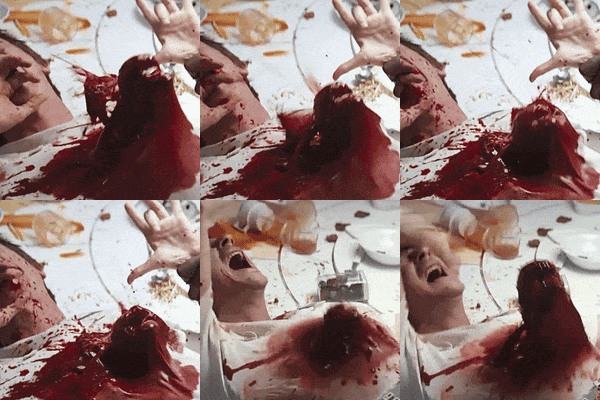
foxhomeent  alien ridley scott chestbursterThere you have it: that’s my dilemma. If I follow my own advice and vote FOR one side rather than AGAINST the other, I am unavoidably voting FOR something I find repulsive. 

Not as repulsive as John Hurt’s gruesome demise in Alien, but not far off. 

Friday, July 11, 2014

Who was Roger of Sicily?


Generally, I shy away from writing about matters of fact. Not because I think – with Ronald Reagan – that facts are stupid things. Rather, it is because opinions are much easier to produce, being essentially incontrovertible. Even if all the premises are wrong, no one can say for definite that the conclusion is when it’s just a matter of opinion.

Furthermore, you may have noticed that ODHSNM house style directs that if a fact is to be stated, it will be phrased thus:
“So anyway, there was this...”
Thereby implicitly casting myself as an unreliable narrator (in the particular vein of a pub bore). In this way, I assume an ambiguously ironic stance to all statements of fact, getting myself off the hook for having to prove the veracity of anything I say. Does he mean it? Or not?

I am, in a sense, simply inviting you to consider (from the aesthetic point of view) the consequences of “what if” these things were true. It saves me a hell of a lot of time, which I would otherwise have to spend making sure that I’m not talking bollocks.

So anyway, there was this time called the Middle Ages with knights and dragons and shit.

We often think – isn’t it? – that the Middle Ages were a barbaric time, when life was nasty, brutish and short. To the extent that we think about it at all.

After the Romans, most people’s grasp of British history is basically (i) Saxons, (ii) some Vikings, (iii) 1066, (iv) “beard and crown” kings, (v) “bob and beret” kings until (vi) Henry VIII.

Beard kings

 And 1066 was “The Norman Conquest”. The Norman era lasted until the 1940s, whereupon the world’s parents decided never to name another child Norman again. FACT.

It may therefore surprise you to discover that the Normans’ story was not exhausted by the Battle of Hastings, keeping Robin Hood down and eventually becoming the English upper class. Oh no.

Bob kings
Turns out, there was this whole other arm of the family which did some rather more exciting stuff than building squat little round castles and churches and logging the contents of Britain in the Domesday Book. Not least in Sicily.

I have no fucking idea what happened in Britain in the 12th century. Monasteries, or something? But from 1130 to 1154, there was this AWESOME Norman king ruling southern Italy, Sicily and a chunk of North Africa. And he was called Roger II.

Read the article is you are REALLY into facts. I came across Roger of Sicily when I was reading “The Middle Sea” by John Julius Norwich, also known as Viscount Norwich.

A viscount, for foreign readers, is a kind of lord here in the UK. Here is a full rundown of the British orders of nobility along with a handy system for remembering it:

6. Baron = Villain
5. Viscount = Biscuit
3=. Count = Vampire
3=. Earl = Hillbilly
2. Marquess = Tent
1. Duke = Alsatian

Anyway, this book is a history of the Mediterranean. I picked it up in an airport a few years ago. And a right rollicking good read it is too.  

And in it – meriting about 3 pages, which is a lot by Lord Biscuit’s standards (ancient Egypt gets about the same) – is this Roger II of Sicily.

He built up a giant kingdom (which I’d never heard of), faced down the Pope and the Holy Roman Emperor and had the good sense never to go on a Crusade. More than that, he actually made his kingdom function properly and – to quote the Wikipedia article:
The king welcomed the learned, and he practiced toleration towards the several creeds, races and languages of his realm.
And that, ladies and gentlemen, is why I took him on as my namesake. At a time when stupidity, thuggery and intolerance reigned here was a ruler who celebrated the life of the mind and didn’t care about the petty differences that divide people.

Showing you the life of the mind

So, at a time when stupidity, thuggery and intolerance reign, I think Roger II of Sicily is a ruler worth remembering. 

Friday, December 13, 2013

The True Meaning of Christmas

I’ve been helping my eldest with his homework: a project on Christmas around the world.

Now, there are no doubt people out there – not ODHSNM readers, of course – who would find this outrageous.

Not me helping my son with his homework. The “around the world” bit. The true meaning of Christmas, they declare, can’t be reduced to some multicultural, relativistic blah blah blah...  - a line of argument which you know full well will inevitably end in someone blurting out the word “Immigrants!”

The true meaning of Christmas, they will say, is...erm...

Well, dear readers, let me put this to you. Christmas is just a celebration of good stuff at a crappy time of year. It has had all sorts of stuff superimposed on it over the centuries, but at the end of the day that’s what it started out as and that’s what it still is.

Don’t give me all that “it’s the birth of Jesus” malarkey. Christ is a late addition to Christmas.

He’s been stuck on top of at least two sets of pre-Christian traditions.

Pagan dessert
Firstly, the Northern European pagan Yule celebrations around the winter solstice. That’s where you get your holly and ivy, your Druidic mistletoe, your Christmas trees, your Yule log (chocolate or otherwise) and all those other Germano-Celto-Scandinavian accessories.

Not one of those things – except perhaps a log – would have been found in the Iron Age Middle East, so have clearly come from somewhere other than the Jesus story.

The second source is Greco-Roman paganism, specifically the festival of Saturnalia.

Saturnalia (Kronoia for the Greeks among us) was a month long celebration of the good old days before that bastard Zeus cursed mankind with the need to work for a living. It involved:
  • Gift giving
  • Eating and drinking to excess
  • A general end-of-term, office party kind of vibe all round, when slaves were afforded freedoms usually denied them and the bosses made fools of themselves

Sounds Christmassy, doesn’t it?

There are loads of other hypotheses kicking about saying that the Christian myth is based on other bits of
Not real
ancient lore, but why get into all that? It’s like arguing about whether Tolkien’s orcs were green or grey. Even if there’s a right answer, it doesn’t matter what it is because it’s ALL MADE UP.

The point is – and I’ll go out on a limb here – it is completely impossible to extract a “true” Christian core or indeed a “true” pagan core. It’s a big syncretic mess of bits and bobs appropriated from here, there and everywhere.

Look at Santa Claus. Where does he fit in? Don’t try to tell me that he’s “really” Saint Nicholas, the fourth century Turkish bishop and early Christian martyr. What the hell would he be doing with reindeer and elves? He’s as obviously mashed up as Baron Samedi.

Balls
Why do you think the Puritans banned Christmas in 1647 as “a popish festival with no biblical justification”? Precisely because they could see how pagan it all was. At least Oliver Cromwell had the balls to recognise it for what it was instead of whinging about the corruption of the “real” meaning on Radio Four.

You can’t select certain bits and say that’s the “real” Christmas and the rest of it isn’t – the Christian bits, the non-Christian bits, whatever. Every step along the way contributed to getting us where we are today. Who can say where taking any of them out would have taken us? There is no distinction between the signal and the noise.

The materialistic aspects of Christmas are just as ancient as the spiritual aspects.

And if we accept that consumerism is our current religion (or substitute for it), then a 50 year tradition of buy-buy-buy from Black Thursday to the January Sales is getting on for half the age of all “ye olde traditions” the Victorians bequeathed us.

It’s as silly to worship a tree or indeed money as it is to worship a big old beardy sky-fairy.  If you pick away rationally at every part of the Christmas myth, eventually you’re left with nothing but a bloody long winter ahead of us.

Maybe we don’t need to have a justification for having a party. The weather’s shit, it’s dark all the time – don’t we have a right to cheer ourselves up?

Perhaps THAT, ladies and gentlemen, is the true meaning of Christmas. 

Thursday, June 27, 2013

Bring Back the Battle of the River Plate

A pocket battleship - HA HA HA
I was shocked and dismayed to discover that the naval battle recreated in Scarborough’s Peasholm Park in the “Scarborough Naval Warfare” event is now presented as fictional.

Because ever since I heard that a park in Scarborough staged a re-enactment of the Battle of the River Plate, I have been yearning with a passion to go and see what must have rated as one of the most randomly bonkers events going.

What does the very name “Scarborough” evoke, more than the 1939 South Atlantic encounter between the German commerce raider Admiral Graf Spee and Commodore Harwood’s Force-G? Nothing, obviously.

Tancred and I recently pitched up in Peasholm Park. Roger Jr had fallen off his scooter and was being examined in Scarborough hospital within an hour of our arriving in the North Yorks Moors on holiday. Elvira was in attendance, and the youngest and I were attempting to salvage some sort of pleasant leisure out of the whole accursed experience.


Roger Jr was fine, by the way – and that hospital’s bad reputation was, as far as we could see, entirely undeserved.

The Naval Warfare event wasn’t on that day, but the ships were out in the lake. Apparently, they are operated by council employees. People’s council tax is being spent training miniature sailors, for god’s sake.

I know that most people today would probably have no idea what the Battle of the River Plate was, or would give a toss if they did know. And that's probably why it was changed.

SCUTTLE! goes the real Graf Spee
But it seems a terrible shame that they – whoever “they” are – have just turned this event into a demonstration of little boats pretending to fight in a lake, rather than a lunatic commemoration of real history. 

Friday, October 12, 2012

Isle of Sodor Railways loses franchise

"Eccentric" Hatt

PRESS RELEASE

Department for Transport, 12/10/12

Transport Secretary Patrick McLoughlin will announce this morning that the Isle of Sodor Railway Company’s franchise for operating passenger and freight services will be not be renewed and will come to an end next April.

Mr McLoughlin cited Isle of Sodor Railways’ appalling record on punctuality and safety – derailments on the network total 255 for the last year alone – as the decisive reasons for rejecting the bid put in by eccentric chairman, Sir Topham Hatt, better known to the public as “The Fat Controller”.

Many critics have laid the blame for the company’s performance on Sir Topham’s “Very Useful Engine” artificial intelligence system, which allows locomotives to make their own route planning and other decisions – frequently in competition with one another.

The Secretary of State also pointed to extensive financial irregularities within Isle of Sodor Railways, which is incorporated in the neighbouring tax haven, the Isle of Man.

Concerns have frequently been raised about the amount of rolling stock and track maintained by Isle of Sodor, which is vastly out of proportion to the needs of an island no more than five miles in length.

Mr McLoughlin will later today hand the franchise to the US-based Consortium For Putting in an Offer for Running Sodor’s Railways – SodOff.

Chuggington: Safety concerns
One of the lead backers of SodOff is the Arizona city of Chuggington. Commentators have noted that Chuggington’s record on accidents is just as bad as Isle of Sodor’s.

Confronted with these concerns, the Secretary of State said in a statement: “They offered shit loads more money.”

Asked for a comment, senior partner at transport engineering consultancy Pig, Rabbit and Cat, Ian “Daddy” Pig said: “Oh. I didn’t expect that to happen”, before jumping up and down in a muddy puddle.

NOTES FOR EDITORS

  • Sir Topham Hatt is the brother of rogue investment banker Sir Stetson “Cowboy” Hatt, the former chief executive of RBS, who has not been missing since 2009. Sir Stetson was last seen leaving Claridges and getting on board Bertie the Bus with 15 teenage Lithuanian prostitutes.
  • Sir Topham first developed the “Very Useful Engine” system in the late 1930s. He spent much of the previous decade in Italy observing how Mussolini made trains run on time. That period is widely believed to be the source of the ardent anti-communism which inspired his desire to run a railway without workers. His feelings about the labour movement led Sir Topham to become a dedicated supporter of Sir Oswald Mosley’s British Union of Fascists, and he was interned for much of the Second World War on Zingzilla Island.

Missing banker Thomas Goldstein
  • Although Isle of Sodor Railways maintains that “Very Useful Engine” is a closely-guarded software secret, allegations that trains are animated with the souls of dead business partners of Hatt, revived by unspeakable necromantic rites, have continually depressed share prices. Longstanding acquaintances of the Hatt family have claimed to see uncanny similarities between certain company assets and the renowned German financiers, Thomas and Percy Goldstein, who vanished in 1936.
  • Spokesman for SodOff, Tinkie Winkie the Teletubbie commented on the DfT’s decision: “Tinkie Winkie bag!”. The FTSE100 and Dow Jones both immediately rose by 100 points. 
Contact DfT press office for further information.

Wednesday, June 6, 2012

Haunting the chapel


I’ve just been robbed by Henry VIII.

Yes, Britain’s favourite wife-killing fatso has cost me about £20 or so 550 years AFTER his death.

“How?”, you may well ask – unless you are already asking “Are you having a psychotic episode, Roger?”

Well, let me tell you – because the erstwhile Tudor monarch could well be reaching out his chubby phantom fingers from beyond the grave to lighten your pockets also if you try to buy a house.

The merrie maniac
Henry VIII, you may recall, was responsible for the dissolution of the monasteries. Much like our present-day rulers, he wanted to grab hold of a load of cash and give some of it to his chums and spend the rest of it on war.

To cut a long story short, when this happened the Church’s liabilities for the repair of church buildings passed to the new owners – which were then generally dumped on the local starving, struggling populace in the form of tithes.

Still with me?

Tithes were then gradually abolished over the following few hundred years.

OR WERE THEY?

Turns out, no one is quite sure if certain bits of land across the country are in fact still liable to pay for repairs to church buildings in whose parishes they may happen to be. The records are sketchy.

In 2003, a couple were charged £100,000 for repairs to an ancient chapel on a farm they had inherited.  The good old House of Lords decided that the Human Rights Act didn’t apply – which is surprising considering how many of its members have undoubtedly inherited ancient chapels.

And so, we return to the present day and the preposterous Chancel Repair Liability Search – for which I have just paid my own tithe, on top of all the other pointless costs on which I have already bent your ears. Eyes. Whatever – sense organs generally. I’m fairly sure I haven’t touched anyone about it.

As I said before, records in this area are sketchy. It’s not clear, even if you check all the available paperwork, whether the property you are buying is potentially liable.

With the same enervating uncertainty as Ant and Dec telling an unpopular celebrity that “it might be you” who has to face the Bushtucker trial (but less than half the charm), Chancel Repair Liability Searches can only tell you that you “might be” liable for a whopping great bill at some unspecified point in the future.

And on what grounds? On the production of some tattered scrap of paper found in the crypt of some OTHER church, which says you are.

That is, if the institution which stands to benefit from finding such evidence digs out documentation which was available only to itself. Now that’s justice.

And so, whither goest risk, hither cometh the insurance industry. You can insure yourself against the danger that you might be financially fucked forever by a law that you not only didn’t know applied to you, but which you couldn’t know applied.

In 2008, the government refused to do anything about this Kafka-esque state of affairs. Its reply to an online petition said:
Chancel Repair Liability has existed for several centuries and the Government has no plans to abolish it or to introduce a scheme for its redemption.  
The Government acknowledges that the existence of a liability for chancel repair will, like any other legal obligation, affect the value of the property in question, but in many cases this effect can be mitigated by relatively inexpensive insurance. It is for the parties involved in a transaction to decide whether or not to take out insurance.

And so the demands of the past over the present are sanctified by the availability of insurance.

Perhaps legal anomalies of this sort are just the price we pay for our “living” constitution – the appendix or coccyx of the body politic.

Indeed, we have many thousands of apparently humorously quaint and charming laws, some 800 of which the Law Commission is looking to get rid of later this year.

Isn’t it delightful that we live in a land where you can technically be pilloried for not tethering your goat correctly on St Swithin’s Day?

No it isn’t – and here, the drummer out of Blur explains why. As he says:
There is no such thing as "technically" being a criminal
Let me paraphrase (and draw perhaps slightly stronger conclusions than a Labour candidate might endorse): these laws put power into the hands of the state which may subsequently be used to suppress activities you had no idea were illegal.

That a person can be criminally liable for something he or she had no idea was illegal and which has never consistently before been treated as illegal is the essence of injustice.

The persistence of these ancient laws is a merkin for the arbitrary exercise of state power – they are the Patriot Act hiding on the village green.

Yeah, it’s only £20 – but it’s the principle of the thing, innit. 

Monday, March 19, 2012

Scott - One hundred years on...


Last week saw a strange coincidence. Firstly, I finished reading "Scott’s Last Expedition" – the diary of Captain Robert Falcon Scott, who died on the way back from being the second person to reach to South Pole.

Secondly, I watched Blue Peter presenter Helen Skelton’s attempt to become the first person to reach the South Pole on a bicycle. For charity. 

Now, I call it a strange coincidence but it’s not really that strange. It is now almost exactly a hundred years since Scott himself died of starvation and cold, eleven miles away from a supply depot. Right now, we are somewhere between the centenary of Captain Oates going outside to his death (pictured above, as imagined by JC Dollman) and the remaining three members of the South Party (Scott, Wilson and Bowers) dying a couple of weeks later.  As such, the country is full of Scott exhibitions, memorabilia and whatnot.

Naturally, I will blissfully ignorant of any of this until I started reading the diary. Indeed, it was this very blog which led me to do – as in December I said that there were no British explorers whose memoirs were free off of the internet, in defence of my reading Norwegian hard-case Fridtjof Nansen’s account of not actually reaching the North Pole in the 1890s.

Having made this categorical statement, I checked the facts of the matter some weeks later – and found that Scott’s Last Expedition is indeed free on t’internet. Don’t worry about it being “Volume 1” – Volume 2 is just all their scientific findings, and dating as they do from a hundred years ago they are all probably completely (and, to our eyes, insanely) wrong.

So, as I said before, I’ve just finished reading it. The main conclusion I reached is that I have now wasted quite enough of my life reading diaries of historic Polar expeditions.

Nansen at least had the decency to go through typically Scandinavian moping bouts of theatrical depression, which he kindly set down in print.

Conversely, the consistent tone of Scott’s diary is one of primly-stiffened upper lip. “The horses have all died. It is probably for the best” – that sort of thing.

Ah yes. The horses.

Now, I am far from an expert in such things, but as both an ENGLISHMAN and a BLOGGER I’ll be DAMNED if I will let that stand in the way of me reaching conclusions I cannot be swayed from that are based purely on my own opinions.

Many people have suggested that Scott’s decision to rely on horse transport was a fatal error. Firstly, it gave the race to the South Pole to Amundsen by making it necessary to start much later that he did (going by dog sled). Secondly, it slowed them down on the way, what with carrying all the necessary hay and other horse food, picking them out of crevasses and getting naughty horse Christopher into his harness every day.

Apparently, Oates himself (the resident horse expert of the expedition) thought that the particular horses they had were dreadful – begging the question, precisely what kind of horse should one expect to be good at climbing over sea ice in a blizzard.

Also, it is in respect of the horses that Scott comes closest (not close, but closest) to admitting that perhaps his preparations were not 100% perfect – when he mentions that they only had one pair of horse snow shoes for the whole party and that they hadn’t actually practised making the horse walk while wearing them. 

Despite, I should add, having had NOTHING TO DO for the preceding six months.

From my own experience, I have noted that horses always look bloody miserable in snow - while dogs absolutely love it. Sadly, nobody asked for my advice, even though it could have saved them. 

I don’t blame the horses for Scott’s failure. Indeed, they were all dead and eaten long before then. But they are indicative of Scott’s attitude – which brings me back to Nansen.

Clearly Scott had read “Farthest North” - he mentions it somewhere. OK, the Arctic isn’t exactly the same as the Antarctic (fewer penguins, more polar bears for starters), but Scott seems completely wilful in his disregard of the lessons on “how not to die while travelling across Polar wastes” that Nansen had released some 20 years earlier.

Did Scott and his party die because of British chauvinism?

Ah yes, I have found the angle for my Guardian column! Certainly, there are a lot of references to the virtues of tea throughout the book.  

Firstly, the Terra Nova expedition took about 40 dogs to pull sledges, but sent them back fairly early in the attempt on the Pole because Scott didn’t believe they would do any good. On what basis, the diary does not mention.

Guess how Roald Amundsen got to the South Pole before him? Guess how Nansen got back from Farthest North? Dogs. Not horses. Or walking.

Secondly, Scott seems to regard skiing as a bit of a novelty – something he could do, but which he didn’t regard it as essential for all the members of his party to be any good at. As far as I can tell, Henry Bowers didn’t ski at all and walked the whole way. 

Thirdly, Nansen went on about how they were far too hot in their fur gear (“wolfskin capes” to be precise). What were Scott and co wearing? Seemingly stuff they’d bought from Milletts. I might also add that as you can see NONE OF THEM had the sense to GROW A BLOODY BIG BEARD as a means of warding off frostbite of the facial areas.

And yet, all those lessons had been available for almost 20 years. Amundsen followed them and he got to the South Pole first, and he got back alive - here he is, feeling the benefit. Scott didn’t follow them. 

Was this the product of the belief that while things like riding on dog sleds, wearing fur, having an inner life etc might be alright for silly foreigners, it was quite unnecessary for British people to do anything quite so dramatic, and that a combination blind optimism and good old amateurism would see them through just fine?

And it’s not just Scott. Let the record also show that Lawrence Oates – who plenty of people right now would canonise – did not regard having had his thigh bone shattered in the Boer War some ten years earlier and one leg shorter than the other as likely to represent any kind of an impediment.

I don’t know. The last section of the book is genuinely moving, particularly the account of Oates’ death.
Should this be found I want these facts recorded. Oates' last thoughts were of his Mother, but immediately before he took pride in thinking that his regiment would be pleased with the bold way in which he met his death. We can testify to his bravery. He has borne intense suffering for weeks without complaint, and to the very last was able and willing to discuss outside subjects. He did not—would not--give up hope to the very end. He was a brave soul. This was the end. He slept through the night before last, hoping not to wake; but he woke in the morning--yesterday. It was blowing a blizzard. He said, 'I am just going outside and may be some time.' He went out into the blizzard and we have not seen him since.
So, some 48 hours after having read this, to see Helen Skelton refusing to kite surf on her way to the South Pole because it was too easy and insisting on riding a bicycle instead made me realise just how much the world has changed in a hundred years.

Again, the strange coincidence of the opening paragraph is perhaps not so strange. She was raising money for Sport Relief, and of course, as the sun begins to show its face for more than a few minutes before and after work, the season of aggressive charity fund-raising is upon us. And I expect she probably chose this particular challenge not entirely without reference to the Scott centenary.

Had Scott taken her route to the South Pole, I think he’d almost certainly have succeeded. Seemingly it was completely flat and the weather was lovely.

That’s not to denigrate Helen Skelton’s achievement. Well done to her indeed. But – and here my Guardian piece turns into a Daily Telegraph piece – doesn’t the world seem a lot smaller when the unconquered wilderness that made heroes out of those who died trying to tame it is now a tourist attraction where people go for an “experience”?

I will say it again. After setting the world record for the fastest 100km kite surf, Helen threw away her kite and decided to carry on by bike – because kite surfing wasn’t hard enough.  

That must have been one hell of a hundred years. 

Tuesday, January 31, 2012

The power of muesli


Along with quiche, salad and tofu, muesli is frequently portrayed as a food that is inherently effeminate and in some way shameful for real men to eat.

Well, I have been eating muesli for breakfast since the New Year (it’s T-325, in case you regard this as another harbinger of the apocalypse) and let me tell you: in the immortal words of Discharge, muesli ain’t no feeble bastard.

The Full English satisfies more, but it leaves one greasy, crapulent and feeling guilty. Fruit and yoghurt...come on. People only eat that (i) in hotels and (ii) for the sake of appearances.

Muesli alone has the power to keep me from feeling hungry until lunchtime without making me want to go back to bed. It is a freaking miracle food.

So why has it become so closely associated with bed-wetters and Liberal Democrats? Maybe it’s the Swiss thing.

So the story goes, muesli was invented in 1900 by Swiss doctor Maximillian Bircher-Benner to feed to the patients in his hospital, after he had been fed something similar by a mystical mountain-dwelling peasant on a hike in the Alps.

We like to think – don’t we? – of the Swiss as a bunch of effete bankers and diplomats, concerned solely with manufacturing clockwork devices and helping criminals avoid taxation.

And yet, this is a nation of hard-ass do-it-yourself mothers who:
  1. Have seen off pretty much every challenger to their political and religious independence (apart from Napoleon) since the 14th century.
  2. Created the first ever democratic multilingual and multiethnic state.
  3. Were, for much of the Middle Ages and Renaissance, the go-to mercenaries for anyone wanting their enemies crushed underfoot, impaled on sea of pikes or chopped to pieces with a halberd. They were the goddam Chechens of the time.

And look at them now. Sat in the middle of a collapsing Europe, winding their cuckoo clocks, eating their Toblerones and telling the rest of the world it’s too poor to come in.

THAT is the nation that gave the world muesli. So mock my breakfast at your peril. 

Wednesday, December 21, 2011

Top ten unfinished blog ideas


It is well-known that even the crappiest article with “top ten” in the headline will be ridiculously over-rated by Google, and therefore attract way more visitors than the content legitimately deserves.

To that end, here is my very own contribution to the entirely unnecessary top ten genre. Like a ruminant, I’m bringing these half-digested ideas back up from one of my many stomachs for a last chew. Too rambling for a Facebook status update, too under-developed for an entire post –here we go, my Xmas gift to you:

1. All the thrill of the escalator

Does anyone else still get a frisson of big city excitement when they go on a “down” escalator? None of the towns I lived in up until the age of 18 had any shops with a down – it was lifts or stairs only for us yokels.

Every time I ride the down escalator, part of me wants to sing “New York, New York”.

2. Now or then?

Is this London St Pancras 2011 or Berlin Templehof 1936? Fascist art is alive and well...

3, Everyone’s a critic

Has anyone here read “The Communist Manifesto”? I did recently, and I was surprised by how clear and modern Marx’s critique of capitalism is. His descriptions of the finance-driven economy are shockingly prescient of the situation we find ourselves in now.

The second half of The Communist Manifesto is also pretty funny, where Marx kick starts the favourite pastime of every leftwinger ever since and slags off every other kind of socialist who has any point of disagreement with him. Because it’s SCIENCE after all.

And does anyone here like Nietzsche? As far as I can see, his demolition of the foundations of Judaeo-Christian ethics in “Beyond Good and Evil” and “The Antichrist” is irrefutable.

The trouble is, both Marx and Nietzsche go on from their brilliantly-argued critique to erect some batshit alternative scheme on top of it – in Marx’s case, communism; in Nietzsche’s case...errr...well, I’m still not entirely sure. Something to do with “act like a Homeric Greek and don’t give a toss about what anyone else does”.

And the funny thing is, both of those two explicitly denigrate “mere critics”. Why is it so easy to knock things down and so hard to produce alternatives?

4. Don’t put your daughter on the internet Mrs Worthington

If you put a picture of your kids as your Facebook profile picture, no one is going to know if you are who they think you are.  

5. Literary heroics (a)

Thanks to Anonymous (for god’s sake people – just put in any old name when you leave a comment...) for pointing me in the direction of Xenophon. I read the whole of “Anabasis” while on jury duty.

“Anabasis” is the ancient Greek “Bravo Two Zero”. Secret mission in Iraq goes wrong, escape from behind enemy lines, fighting all the way – sound familiar? ANCIENT GREECE IS NOT BORING!

6. Literary Heroics (b)

Whoooooooooooooooooooooooooo lives in a pineapple under the sea? FRIDTJOF NANSEN!

If Xenophon is Andy McNab, Fridtjof Nansen is Bear Grylls – but without the overnight hotels. I just read “Farthest North”, relating his polar expedition of 1893 to 1896. That’s right – three years in a wooden ship on the Arctic Ocean.  

In fairness, there are times when the repetitive prose manages to not only describe the ball-aching boredom he suffered being frozen into pack ice with 13 Norwegians waiting to drift to Greenland but also to elicit it. I could only care so much about what they had for dinner EVERY DAY FOR THREE YEARS. "Took the latitude. We have drifted 12 feet north in the last week. Took a sounding. The sea is very deep. It's been night for six months. Thought I saw a polar bear, but I didn't. I am so bored."

But the unbelievable fortitude of the man – a man of action, and of science and (later) a humanitarian statesman - is just inspiring. Sure, there are plenty of British polar explorers I could have idolised. But their books were not free! Nor did any of them have quite such an impressive moustache and stare. 

7. Vests are not outerwear

It is not acceptable to wear just a vest in public in the UK if you are a man. Even if it’s hot.  Especially when it’s cold.

Also, is it wrong that when I hear the line “don we now our gay apparel” in “Deck the halls with boughs of holly” I can’t help but think of assless chaps?

8. The most revolting cocktail ever

I give you the “Scotti”.  

9. The day I quit the gym

I cancelled my gym membership – and had to work out a three month notice period @£72 a month! Outrageous. If anyone has any ideas on how I can avoid turning into Jabba the Hutt, I’d be most grateful for your input.

10. And then the abyss stared back into me

The trouble with writing a blog is that when I meet people in the real world, I don’t have anything left to say to them. In telling every interesting anecdote I have on here, and polishing and grinding down the sharp edges on the facts until it becomes a routine or a bit of schtick, I lose the will to ever mention it again. 


Friday, November 4, 2011

The Dukes of Moral Hazard


After praising the Greek government for sticking to its guns on a referendum on the bailout package yesterday, I was rather surprised to find that some 15 minutes after I had published it, Papandreou had changed his mind. The ODHSNM kiss of death strikes again. 

Suddenly George had decided that “democracy” meant something a little less Athenian and bit more Burkean than he’d previously been inclined to lead the world to believe.

By that, I mean:
  1. Because the parliamentary opposition supported the bailout – no doubt after having their children taken hostage by G20 agents and spirited to a bunker in Cannes – there was, in fact, total agreement in the Greek polity on the whole “selling oneself and one’s descendants into slavery” issue.
  2. The general public had their chance for a say when they elected their MPs. No point whinging about it now Stavros. Just eat your grass and be quiet. 

So, well done everyone - especially Existential Doubt for his article explaining WTF brought us to this moment. That’s the crisis over.

Well, call me paranoid and a prophet of doom, but I’m glad Elvira and I decided to book our upcoming break in a non-Euro country (the Czech Republic, since you ask).

While flights might be cheaper after the Euro has collapsed, I don’t want the added hassle of bartering for food, huddling around burning pieces of furniture in an exploded basement overnight and fending off marauding barbarians during the day on top of the usual stresses of a holiday.

Yes, well done EU and G20. The banks can rest easy knowing that there’s nothing you won’t do to stop them losing a penny. Things are going so well.

While we’re at it, EU, why not finish the job properly? All the governments – step down. Let’s get a Hapsburg on the throne and change the name back to "Holy Roman Empire".

Thursday, October 20, 2011

Remember, remember what actually happened


The demand that x, y or z "should be banned" is regularly heard these days – generally directed at things or ways of behaving that the demander personally doesn't like.

No matter how liberal, libertarian or laissez-faire an individual is most of the time, pick on something they subjectively object to and you can generally rely on the fascist within to surface and call for the coercive power of the state to be thrown behind the removal of other people's freedoms to do, be or have something they disapprove of.

So it is not without some trepidation and discomfort that I ask "why in god's name doesn't the government ban the public sale of fireworks?"

From now until around early December, every night is Bonfire Night for someone. As soon as it gets dark until around 11pm, someone somewhere within earshot of your house is going to be setting off small incendiary bombs for their own amusement without regard to the welfare of you, your kids, your pets, farm animals etc etc.

No doubt some of them will be maimed or killed – as they are every year – and a load of buildings will be burned down, either by stupidity or intentional malice or the combination of both that appears to be the hallmark of 21st century Britain.

It seems crazy to me that, when pretty much every other way of behaving anti-socially or self-destructively is on the Nanny State's agenda for eradication, the selling of explosives to children and drunks for use in their own homes is not higher up the list.

At the moment though, it's not just fireworks that are dragging out the whole Bonfire Night misery over an ever-growing stretch of the year. Disaffected middle class people the world over seem to have adopted the image of Guy Fawkes from the film V for Vendetta as in some way symbolic of their tiresome festival/holiday/protests against capitalism.

Never mind that every V mask purchased profits Time Warner (Dow Jones – TWX; current market capitalisation - around $35 billion; preferred economic system – capitalism). Guy Fawkes is a pretty crap symbol of anti-authoritarianism.

When he tried to blow up the Houses of Parliament and King James I in 1605, Fawkes and his pals were emphatically NOT doing it in the name of democracy, freedom, socialism, organic wind farms or anything else that our protesting friends would believe in.

He was, in fact, trying to kill a Protestant king in order to put a Catholic monarch on the throne. I've got nothing against Catholics TODAY, but the experience of sectarian strife under the last two explicitly Catholic British monarchs – Mary and James II – suggests this would have led to the destruction of any nascent democratic stirrings in a torrent of blood and burning heretics.

That's not to say, of course, that the Protestant royals of the time were any less inclined towards violent repression on religious grounds. The main problem, I reckon, was perhaps more that back then rulers felt that political power implied a right to slaughter not only anyone who didn't DO what they wanted them to do, but also didn't THINK what they wanted them to think.

Nevertheless, I think if you look at the history of Protestant countries and Catholic countries in Europe from the 1600s onwards, it seems reasonable to conclude that the former ended up rather more liberal and democratic a lot more quickly than the latter. That's just what happened in history, innit?

Anyway - in the same way that pseudo radicals are content to forget that dear old Che Guevara ordered the execution of civilians because he looks good on a T shirt, only someone who didn't really have a clue what Guy Fawkes was trying to achieve would adopt him as a democratic icon. 

Wednesday, September 28, 2011

Adventures in moustachismo


It was not an idle threat. I really have grown a handlebar moustache – albeit a fairly discrete one, which I can just about go around in public unremarked on when it's unwaxed and downward pointing.

Here are some of my reflections on it:

1. Moustache wax, when applied without the aid of a mirror, does have the appearance of semi-dried-in mucus. No one likes a careless sneezer.

2. Victorian men must have drunk exclusively using straws, because it is impossible to drink – say – a pint without absorbing a lot of beer into the moustache through capillary action. I have been unable to find pictorial confirmation of this (on Google), and therefore assume there is a conspiracy to suppress this information.  

3. I can now quite easily pass myself off as Belgian. If I have a dog in a coat with me, the disguise is impenetrable.

4. Trimming a large moustache is hard work, particularly if you are not 100% ambidextrous. Careless topiary results in a disagreeable asymmetry. Failure to trim leads quickly to the sort of regrettable display depicted above.

5. Women – specifically but not limited to my wife – are generally not appreciative of the delights of the moustache. 

Tuesday, August 16, 2011

A remedy for society's ills

So while the government fumbles around trying to decide which recipe of "same old shit" to serve the country in the aftermath of last week's rioting – almost certainly with a squirt of "...but worse" topping – I've taken matters into my own hands.

I am challenging the sick culture of the early 21st century by growing a big bushy handlebar moustache.

Now, I know that this is does not fall anywhere on the conventional left-right spectrum of "what to do" responses that have been aired in the last few days, which has generally covered the more familiar options from "give them more free stuff" to "spray nerve gas on them".

To that my answer is – so much the worse for conventional left-right distinctions. I'm growing a moustache and you can interpret that however you want. It's not retro. It's not ironic. If Eugene Hutz can do it and still be this cool, why can't I?

Throughout history men have had the freedom to grow all sorts of crazy hair on their faces and get away with it. The 19th century and the first half of the 20th century represent the apex of this trend.

The Second World War killed off a lot of moustaches. Most effectively, I suppose, by killing an awful lot of people with moustaches. Perhaps – as with the British car industry - the critical mass of skills was lost. Perhaps after all that, shaping a moustache seemed rather pointless.

Some moustaches died by the company they kept. The toothbrush moustache of Charlie Chaplin and Oliver Hardy never escaped its association with Hitler, although his equally-distinctive side parting got away with it – eerily paralleling the respective roles of Jade Goody and Danielle Lloyd in the 2007 Celebrity Big Brother race row.

Just ten years ago, it was fairly unusual to see anyone with facial hair below the age of 30. But today, one just has to look around to see acres of sparse, wispy, "is it or isn't it?" beard adorning the faces of pasty youths, clad in their androgynous uniform of nerd glasses, jeggings and ballet shoes. Something, I fear, has been lost to the meaning of the moustache in this barrage of bumfluff.

Reclaiming the moustache fills me with not a little apprehension. I can't help but think that in taking this step, I am making a very significant statement. People are going to make assumptions about my politics, my personality and my sexual proclivities on the basis of what's on my upper lip as soon as I start waxing it. At best, I'm going to be called "eccentric"...

Still, I'm married, I've got two kids, I have a decent job and I have the self-confidence to look like Friedrich Nietzsche – what do I care what conclusions strangers leap to about me?

I REJECT the tyranny of conformism.

Thus spake Zarathustra.