Showing posts with label Fantasy government. Show all posts

Tuesday, June 21, 2016

Welcome Back My Friends To The Shitshow That Never Ends...

A week certainly is a long time, in anti-politics just as much as in politics.

I wrote one version of this post last Wednesday and planned to publish it on Thursday or Friday. Then someone murdered an MP, allegedly shouting “Britain First” and then (on court record) giving his name as “death to traitors, freedom for Britain”.

Suddenly, the warnings I had jotted down that neither losing side would accept the result of Thursday’s referendum – such was the corrosion of commitment to democratic compromise and conspiratorialism the campaign had exposed – looked like truisms hardly worth stating.

Can the liver of British society filter out all this venom, or will it succumb to cirrhosis? Both sides have already got their respective Dolchstosslegendes to blame the stupid or “confused” voters or the establishment and the experts in its pockets ready, and are no doubt preparing their respective Werwolf Organisations to carry on stay-behind operations in future enemy territory.

If anything, the whole shitshow has demonstrated how thin the veneer of commitment to democratic and liberal values – when the chips are really down - is among large parts of the British public.

Well, to hell with you all:
  • To hell with the Remainers who think that people who don’t agree with them are too thick to be allowed to vote.
  • To hell with the Brexiters who are so irresponsible that they will cynically whip up a latent racism that their leaders (probably) don’t even believe in for votes
  • AND to hell with the smirking abstainers, making their impotence a badge of honour, who would rather preserve their immaculate lack of responsibility for anything than have to make a serious choice.

A place for sanctimonious posturing, more like
It’s clear to me (now) that political apathy and the lack of difference between the parties are the only reasons we don’t have to endure this sort of theatre of hate every five years. I suppose Scotland gave us some hints of what would happen – where plenty of ultras are still denying the validity of the result two years on. We should do more to foster apathy and to lower the stakes in future.

But this time, the stakes are really high.

If you don’t stand up for what you have or what you want, then what you get is what you deserve.  

I have voted Remain for reasons relating to me and my family. You may disagree, and that’s your right. If you disagree, use what leverage you have to bring about your favoured outcome. I can respect people who vote Leave, even if they’re voting for reasons I think are bad reasons. I have no respect for people who stand by and dodge responsibility. So I will say it again:

If you don’t stand up for what you have or what you want, then what you get is what you deserve.  

Thursday, June 2, 2016

Whoever Wins We Lose

That was the strapline for 2004’s “AVP: Alien vs Predator” - a showdown between two hideous, misanthropic powers in which ordinary people like you and I feature only as collateral damage. Does that sound familiar?

Yes, it's another post about the EU referendum. 

Given the choice between having a living embryo implanted in me which would eventually gnaw its way out of my chest and being hunted for sport, I would probably have to come down in support of the Predator.

But when it comes to voting for Brexit or Bremain, it’s not quite such a clear-cut choice. Our ballot papers arrived yesterday and - having just last week urged all of you to vote FOR something rather than AGAINST - I don’t know what I’m going to do. Brabstention is not an option, but Brapathy and Brisgust are exerting a lot of Brinertia on me.

Why it’s hard to vote Brexit
At the risk of offending my bien-pensant friends who suffer no such atavistic urges, there’s a part of me that wants to vote Brexit. It’s roughly the same part that made me an insufferable teenage wannabe Marxist windbag, an insufferable “punker than thou” music snob and various other species of insufferable arse over the years.

It’s that “anti” attitude which makes one’s default position one of opposition to/distaste for whatever exists in favour of an alternative that doesn’t. 

“Some men just want to watch the world burn”, said butler Alfred in The Dark Knight (a film about a man who dresses up as a bat to fight a man who dresses up as a clown). I’m not sure if that’s quite Roger of Sicily, but I certainly am one of those people who is attracted by a desire to see the look on a lot of people’s faces the day after a “Leave” vote.

But then I think about Boris Johnson’s face and Nigel Farage’s face… And I think, as much as I would like to treat “the issues” completely separately from “the personalities”, it’s these awful people who would be the power in the land come June 23rd.

And as well as believing in leaving the EU (debatable in Boris Johnson’s case), most of these people also hold a lot of other opinions I strongly disagree with. Intellectual, libertarian Brexiteers like Douglas Carswell have disappeared, so that voting in favour of leaving the EU cannot be separated from voting in favour of a whole lot of nativist, racist, social-authoritarian, revanchist “back to the Empire” idiocy. 

We do not have the option of voting for one without voting for the other. Some people are happy with that, but I’m not.
The downside of the Singaporean model

A case could be made for a post-EU Britain reviving itself economically and culturally once the dead hand of Brussels was cast off - although the only version I’ve seen to date is a suggestion that we follow the example of Lee Kuan Yew’s Singapore, which is hardly a great model for liberals and democrats.

However, the forces that would take power in the event of a Brexit vote have no idea of how they would achieve that. If they do, they’re keeping it quiet, because I can only assume that it would be to subject the UK to the sort of neo-Thatcherite deregulatory shock therapy the former Eastern Bloc underwent after 1989.

The Brexit camps encompass a lot of different positions, but it’s the entitled, right wing, economic know-nothings who would be in power in Brexit wins. That’s the problem. And that's why I have trouble voting for them.

Why it’s hard to vote Bremain
“I'll forgive and forget, If you say you'll never go. 'Cos its true what they say - It's better the devil you know” said Kylie Miongue in her 1990 number 2 hit, “Better The Devil You Know”.

If taken literally, that is surely one of the most pessimistic and retrograde messages ever committed to CD, vinyl and cassette. Yet it is the sum total of the Remain camp’s argument: everything will be worse if you seek change. You are powerless to improve your lot in life, so surrender to your fate.

Thanks a lot Kylie.

Let me make one thing clear: I love the many different cultures and peoples of Europe. I feel a shared sense of pride in our cultural and economic achievements and a shared sense of shame and humility in the face of our crimes and tragedies. It’s obvious that in a globalised world, some things are better done at a supranational level. I love the German language, French wine, Spanish holidays, Scandinavian crime dramas, Greek philosophy, Balkan brass bands, full English breakfasts, Italian coffee, Slovenian avant-garde industrial music, Swiss AND Belgian chocolate and more. I think I am as far from a Little Englander as it’s possible to be. A real union of Europe would be a magnificent thing. 

But the European Union we actually have is a rotten, corporatist, undemocratic mess. Surely the negativity of the Remain campaign reflects the fact that when you consider the EU on its own merits - as opposed to the spirit it is intended to (but does not) embody or the merits of others it ascribes to itself (eg lack of European war) - it's pretty hard to get enthusiastic about. 

Within the EU, the idea that every political problem has a technocratic solution has metastatized into a self-congratulatory, anti-pluralist “because we say so”, embodied in Jean-Claude Juncker’s warning that “deserters will not be welcomed back” in the event of a Brexit vote.

If the technocrats were competent you might have more sympathy, but they’re not. The story of Greece is just the most glaring example - allowed into the Euro on data everyone knew was false to prove a political point, now reduced to penury for the sake of international bondholders. And that’s what happens to non-deserters...

Europe will continue to exist and Britain will continue to be a part of Europe whether the UK is in the EU or not. Whether the EU survives much longer with or without the UK is another question entirely. 

So endorsing our continued participation in this arrogant shambles is something I find it hard to put my vote towards. 

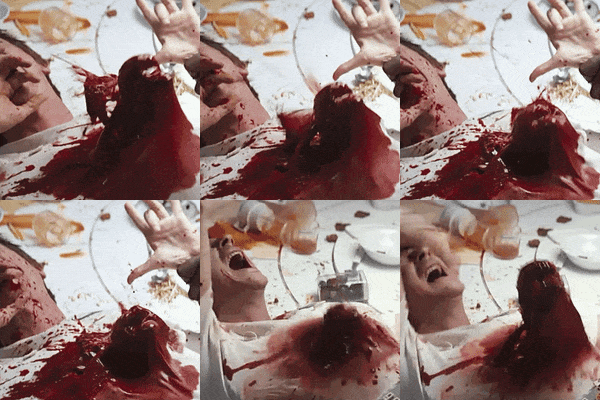
foxhomeent  alien ridley scott chestbursterThere you have it: that’s my dilemma. If I follow my own advice and vote FOR one side rather than AGAINST the other, I am unavoidably voting FOR something I find repulsive. 

Not as repulsive as John Hurt’s gruesome demise in Alien, but not far off. 

Thursday, May 26, 2016

Don't Make Me Think!

Along with “when is ODHSNM coming back?” and “what are you doing behind those bushes?”, the question I have been asked most in recent months is “how should I vote in the EU referendum?”

Long-time readers will recall that this blog has been on the wrong side of every major political controversy of recent years – from proportional representation, through Scottish independence, to Albania’s 2011 Eurovision entry.

As such, the hordes of journalists, pundits and other halfwit gobshites that make up “the media” have been clamouring (so far fruitlessly) to elicit the views of Roger of Sicily – knowing, of course, that whatever he says will be precisely that thing which fails to come to pass. Like the political inverse of Paul the psychic octopus.  
My molluscular counterpart

Well, before I give you your instructions, let me talk about the two campaigns for a moment. Last year, I said that the 2015 general election campaign was depressing, but never have I seen a more dismal spectacle than both sides of this EU referendum debate.

Remain appears not to have a positive case to put for EU membership, or if they do they are afraid to make it, and so fall back on increasingly laughable and outlandish claims about how terrible the consequences of not voting for them will be.

Leave, in turn, seems to have gone beyond making any sort of argument for its point of view and just wants to stamp its feet and shout about how everything is unfair – like a surly five-year-old up long past his bedtime.  

Both campaigns – like the Donald Trump phenomenon in the USA – show how we are now in a post-factual political culture. I’m not claiming that coinage – I got it from this article, but it’s probably been around for ages. As Ronald Reagan said (or maybe he didn’t) “facts are stupid things”.

To the partisans of both sides, facts are only facts to the extent that they support their particular point of view. Claims of fact that contradict it are not simply mistaken – they are wilful, deliberate lies put forth by the selfish (if not outright evil) opposition to manipulate you, you poor innocent dupe.

There are good arguments to be made for staying in the EU. And there are good arguments to be made for leaving the EU. Some of those arguments - on both sides – are based on true facts about the world. Some of them are based on value-judgments, which I don’t believe can ever be true or false. I’m kinda old fashioned in believing that the world we live in is a mixture of facts and values, that aren’t always compatible with one another.  

There are good arguments on both sides of his referendum debate, but no one appears to be making them. We seem to have reached a point where every genuine point of disagreement devolves into “culture war”, which is an infantile kind of politics. It comes from the same place as the ever-growing enthusiasm for conspiracy theories – and that place is simply intellectual laziness.

It’s laziness that’s the problem with “the public” – it’s not stupidity.

Because it’s hard to deal with a situation where both sides can be partly right and partly wrong, and you have to choose between options that aren’t simply black and white, isn’t it? And it’s even harder to take responsibility for your choice!

It’s a lot easier to say that you are right because your heart is in the right place; that facts that don’t fit are lies; and that people who disagree with you are not just wrong but also bad.

Not the answer
Just like it’s a lot easier to say that everything is controlled by corporations or the Jews or space lizards than it is to admit that the world is complicated and maybe – just maybe – you don’t actually understand all of it.

Just like it’s so much easier to say “they’re all the same” than it is to listen to what the differences are and take the responsibility of judging and justifying your judgement.

What depresses me the most is how this line of argument (if you can call it that) has been taken up by ordinary people. My Facebook news feed (for example) is full of people I otherwise like and respect, on both sides, making the most ridiculous claims – not about the merits of their own opinions, but of the malign intentions of anyone who holds the opposing view. Again and again, I see the opinion-cart put in front of the fact-horse, without regard to the stable door of complex, imperfect reality.

I’m as bad as any of you. I’m sitting here behind my ironic facade – does he really mean it? Or is he joking? Who will be the first to pose the immortal question “U OK hun?”

No, I’m not going to tell you how to vote. I don’t know how I’m going to vote, and when I do, I will take responsibility for it.  Just vote however you’re going to vote for the right reasons. Don’t vote against anyone. Vote for something.


Monday, April 20, 2015

It's Not You - It's Me

“In a democracy people get the leaders they deserve,” said Joseph de Maistre. He didn’t mean it in a good way.

I have lived through quite a few general election campaigns and paid good deal of attention to the last few. I have never witnessed one this depressing.

It has, however, at least given us something new – alongside the traditional all-you-can-eat dogshit buffet – in the form of parties campaigning on the basis of who a vote for them would exclude from a future coalition government.

That the political parties and the media have utter, naked contempt for us – the voters – is not new.
But in the past, the voters have always at least been allowed the “king for a day, fool for a lifetime” privilege of being treated as though it was them who choose the government. Not this time. Now we are being treated to the spectacle of post-election coalition wrangling before any ballots have even been cast.

As anyone who voted Lib Dem or Conservative in 2010 – and cared – will have noticed, you can’t be sure that what it says on the tin bears even the scantest resemblance to what’s inside any more. Not, of course, that you ever could, I suppose. It was a “coalition” of a different sort that inflicted the Iraq War on the world.

I'd much rather have than one of these than a school for my kids
It’s a common lament that the political media focuses too much on personalities and not enough on policies. That’s true up to a point: apart from being pretty sure that whoever wins, taxpayers like me will be expected to stump up £100 billion for Trident (the most expensive sock stuffed down the underpants in human history), I have very little idea what else the various parties are offering. Or rather are pretending to offer right now in the hope of fooling enough of us peasants into putting them in power so that – much like Charles I – they can do whatever the fuck they like without reference to us for five more years.


OK, so the political class despises us and we despise them. But considering how many needy neurotics the British public is clearly made up of, it surprises me how rarely anyone seems to wonder “what if it’s not everyone else – what if it’s me?”

What if the public gets held in contempt because it never disproves that it is WORTHY of contempt? In the past, people could kid themselves that it was the papers shoving “who is the best-dressed leader’s wife?” articles down their throats – now the analytics will prove that THIS IS WHAT THEY WANT, if they have to have politics at all.

So what’s the answer? Well, clearly not voting isn’t it.

A year or so ago (back when I used to blog regularly...) I wrote in praise of Russell Brand and his anti-voting point of view. Actually, it was less a blog about Russell Brand and more of an opportunity to quote long passages from HG Wells, with whom I was then obsessed.

Over a hundred years ago – A HUNDRED YEARS AGO! - Wells said that democratic elections give ordinary people “an exasperating fragment of choice between the agents of two party organisations, over neither of which he has any intelligible control”.

All that’s changed is the number of party organisations.

Best-dressed party leader, 1922
Churchill said:
Democracy is the worst form of government, except for all those other forms that have been tried from time to time.
I sympathise a bit with the idea of refusing to participate in a charade of democracy. But then I have no doubt whatsoever that the people who make it most frequently and loudly are precisely those who would shirk the responsibility of an active, participatory democracy most vigorously.

It IS much easier to criticise than to come up with a constructive alternative - and it's even easier to parrot criticisms other people have thought up for you. 

That doesn’t mean that your criticisms should be ignored just because you don’t have all the answers. But if all the carping about politicians all being the same etc was put to some constructive use – who knows? – maybe an alternative that doesn’t equate everything that is not precisely what we have now with totalitarianism or dictatorship could be figured out.

We get bland mannequins like Cameron and Miliband because we demand them. We have earned them. 90% of government is administration and the remaining 10% is presentation (mostly making out that the other is Hitler or Mao or whatever).

Come on! The difference between “destroying the NHS” and “saving the NHS” is a fractional difference in budget and private sector involvement AND YOU KNOW that any promise made on these points will be treated as negotiable in future. What we are seeing on a large scale is the narcissism of small differences literally played out in all its tribal idiocy.

They don’t believe it. You don’t believe it. So why are we doing this at all?

Saturday, September 13, 2014

You'll Take the High Road and I'll Take the Low Road

This Thursday, Scotland will have its long-awaited referendum on whether to become an independent country. A week or so ago, one single poll gave a tiny majority to those in favour – which has turned the Scottish question from a matter of purely local interest to the leading issue in British politics. For the moment.

The No Campaign, aka Better Together, has rightly taken a lot of stick for its abysmal campaign. Not only has it given nobody in Scotland a better reason to stay in the UK than the fear of something worse – missing the point entirely that the Yes Campaign’s principal appeal lies with the hope of something better.

Better Together’s hopelessness was funny until that poll last weekend startled the powers behind the campaign out of their complacency. The week just gone has seen, on the one hand the pitiful spectacle of the three main party leaders crawling up to Scotland to tell them how important the Scots are to Britain – after having treated the whole affair up to that point as having all the interest to them of a parish council by election. Too little, too late boys, although it was fun to see David Cameron talk about the “effing Tories”.

On the other hand, it has seen naked economic threats as various businesses based in Scotland (Standard Life) or doing a lot of business there  (BP) have “come out against independence”. As other people have pointed out, BP has no trouble doing business in countries like Russia and Zimbabwe, so quite what they’re afraid of happening in Scotland is unclear.

It’s depressing, isn’t it? The primary line of argument anyone was able to think of to keep the UK going started off as “think of all the things that could go wrong with your economy” and developed into “we will fuck your economy up if you don’t do what suits us”.

Scotland’s case is not really helped when some nutjob SNP types start calling for BP to be nationalised though. Nice one! That will bring the foreign investment flooding in!

If I was the sort of person who was able to develop a rational argument and see it through to a strong conclusion, I’d like to think I could have gone on to write something like this piece by Fintan O’Toole in the Guardian. Unfortunately, I am not that focused. So I’ll link to it instead and let you read it and be astonished at my perspicacity in having brought it to your attention...

For many people in Scotland, this may well be a matter of ethnic nationalism. Some of them may really hate “the English” and regard the 1707 Act of Union as colonisation.

For far more (I hope, at any rate), this is being seen as an opportunity to take back a stake in politics from a distant, uninterested Westminster. You don’t have to think Alex Salmond is any better than any of the other leaders to believe that decisions that affect you, your family and your friends should be made nearer to those people rather than further away.

That, I think, is what the British malaise about politics stems from – decisions that affect us are made far, far away from us. Geographically if you live in Scotland, but in all sorts of other respects as well.

It’s sharpened to an edge capable of cutting through only by the “national” fault line in the case of Scotland. As O’Toole says:
The Scottish independence referendum poses a very good question but suggests an inadequate answer. The question is: where does power lie? This is not a marginal problem to pose in a 21st century democracy. It cuts to the heart of a deep crisis in the relationship between people and politics. But the answer implied on the ballot paper is a geographical one: power lies in either London or Edinburgh. Most Scots – and most of the rest of us – know that while this choice is far from meaningless, it also rather misses the point.
Most people are still so bewitched by the 19th century idea of the nation state that they can only imagine a group of people wanting to govern themselves, in their own interests, if they form a “national” group. Whether they acknowledge the legitimacy of that wish depends entirely on how they feel about that group (see, oh, I don’t know...the entire history of the 20th century, for example).

One of the few things I remember from my political theory degree was a quote by a chap called Benedict Anderson, who called nationalities “imagined communities”.

That in turn made me think about all the people bleating last week about how their British identity was going to be harmed by the Scots becoming independent.

If they want to imagine another community, surely that’s up to them? And if it pains you so much, well, why not just carry on imagining that they’re still in your imaginary community? Are you still imaging the Irish in it too? Why don't we add some others? The Norwegians, perhaps. They're very tidy. 

That’s the psycho-cultural bit taken care of. If the Scots don’t feel like part of the same imagined community as us...well, that’s that really isn’t it? You can’t force them to imagine themselves as part of the same community as you.

SUBHEADING - It breaks up the text

But suppose they do still see themselves as British. Why does that HAVE TO entail being governed from Westminster under a single unitary state entity? It only does when you start assuming in mystical qualities about “proper” communities and their “natural” territories and (dare I say it) “god-given” rights.

The best reasons for Britain being governed by a single government are military reasons. This is an island, and a whole island is easy to defend. If someone else is in charge of part of the island, then you don’t have the natural advantages of being an island.

Britain being invaded is unimaginable. England being invaded with the connivance of a hostile Scotland is beyond unimaginable. We’re living in the 21st century, FFS.

If anyone can tell me point out anything else that is ideally organised on the precise level of “the United Kingdom of Great Britain and Northern Ireland” (plus its various overseas territories) then I’d be astonished.

Hence, large areas of policy are governed at the European level – precisely because markets bigger than the UK are more profitable, a trading bloc bigger than the UK has more international clout, standards in goods and services that are heavily traded need to be common across areas bigger than the UK etc etc.

But things should only be managed in bigger blocs, further away from the people affected, when that is efficient.

That old EU chestnut “subsidiarity” should be the norm and it should start at home. Power should be exercised as close to the people as possible, and it should ONLY be moved upwards to more distant, larger institutions when smaller bodies are clearly unable to do a good job.

I don’t think that nation states have a special privileged position above supranational bodies and subnational bodies. They are not the fount from while all authority flows upwards and downwards.

The idea that Britain will lose its seat at the top table internationally without Scotland is equally ridiculous. First and foremost, I believe that governments and states are there to promote the welfare of the people who live in their jurisdictions – and so international clout is only a means to that end, nothing more. National prestige for its own sake is meaningless.

Secondly, are we still sitting at the top table? Or are we on a little card table extension the USA has shoved onto the end to save our embarrassment when we turned up uninvited?
The other Alex S

Alexander Solzhenitsyn pointed out that only defeat can really bring a country to terms with itself –
never having recognised itself as having been defeated, Britain has no sense of its real place in the world. If losing Scotland forces a reassessment of Britain’s idiot pretensions and forces it to look at itself, so much the better.

So, for all these reasons, I don’t think that Scotland being “another country” is a big deal at all. The trains will still go there, 300,000 Scots will still live in London, money will continue to flow north and south, and we’ll all feel the same about each other as we do now (ie general lack of interest) - but they will be running their affairs and we will be running ours.

How does that undermine anybody’s identity?


Whatever happens on Thursday – this whole process has opened up the kind of thinking and reflection you don’t often see in this country. If for no other reason, it will have done Britain some good because of that. 

Monday, September 8, 2014

Exposed: The Lines 'Better Together' Didn't Use

Crippling export duties to bring Scotland to its knees
Confidential documents from the Better Together campaign obtained exclusively by Oh Dear. How Sad. Never Mind. reveal some of the reasons considered as to why Scotland should reject independence in the upcoming referendum.

Although no spokesman for either side has yet commented on the leaked documents, ODHSNM believes it is its journalistic responsibility to publish them, just in case they are not completely made up. 
  1. If Scotland votes for independence, everyone in England will refer to it as “Pooland”.
  2. No more Buckfast for you.
  3. Not only can you not keep the pound, but under cover of darkness on September 20th, SAS units will steal all the proper sterling currency within Scottish territory and replace it with those crappy Scottish notes that no one accepts.
  4. Prince Charles will cry and set fire to all of his kilts.
  5. It is only the constant vigiliance of secret radar installations based in North Yorkshire that stop hordes of Loch Ness Monsters from bursting out of their watery lairs and overrunning the Highlands. They eat oil, too
  6. MI5 will leak naked pictures of Alex Salmond. 
  7. Independence has been shown to cause increase incidences of impetigo, dwarfism and homosexuality.
  8. Masked men speaking with Russian accents have been noticed gathering around Aberdeen, while Vladimir Putin was recently spotted wearing a Tam O’Shanter and ginger wig.
  9. You have to keep Gordon Brown.
"For real - I took this picture", Alistair Darling is quoted as saying
It is unknown why these lines were never used, however the documents had four words scrawled over them in red biro:
 “Yes, but: George Osborne”
There. You see: I can do satire. 

Friday, July 11, 2014

Who was Roger of Sicily?


Generally, I shy away from writing about matters of fact. Not because I think – with Ronald Reagan – that facts are stupid things. Rather, it is because opinions are much easier to produce, being essentially incontrovertible. Even if all the premises are wrong, no one can say for definite that the conclusion is when it’s just a matter of opinion.

Furthermore, you may have noticed that ODHSNM house style directs that if a fact is to be stated, it will be phrased thus:
“So anyway, there was this...”
Thereby implicitly casting myself as an unreliable narrator (in the particular vein of a pub bore). In this way, I assume an ambiguously ironic stance to all statements of fact, getting myself off the hook for having to prove the veracity of anything I say. Does he mean it? Or not?

I am, in a sense, simply inviting you to consider (from the aesthetic point of view) the consequences of “what if” these things were true. It saves me a hell of a lot of time, which I would otherwise have to spend making sure that I’m not talking bollocks.

So anyway, there was this time called the Middle Ages with knights and dragons and shit.

We often think – isn’t it? – that the Middle Ages were a barbaric time, when life was nasty, brutish and short. To the extent that we think about it at all.

After the Romans, most people’s grasp of British history is basically (i) Saxons, (ii) some Vikings, (iii) 1066, (iv) “beard and crown” kings, (v) “bob and beret” kings until (vi) Henry VIII.

Beard kings

 And 1066 was “The Norman Conquest”. The Norman era lasted until the 1940s, whereupon the world’s parents decided never to name another child Norman again. FACT.

It may therefore surprise you to discover that the Normans’ story was not exhausted by the Battle of Hastings, keeping Robin Hood down and eventually becoming the English upper class. Oh no.

Bob kings
Turns out, there was this whole other arm of the family which did some rather more exciting stuff than building squat little round castles and churches and logging the contents of Britain in the Domesday Book. Not least in Sicily.

I have no fucking idea what happened in Britain in the 12th century. Monasteries, or something? But from 1130 to 1154, there was this AWESOME Norman king ruling southern Italy, Sicily and a chunk of North Africa. And he was called Roger II.

Read the article is you are REALLY into facts. I came across Roger of Sicily when I was reading “The Middle Sea” by John Julius Norwich, also known as Viscount Norwich.

A viscount, for foreign readers, is a kind of lord here in the UK. Here is a full rundown of the British orders of nobility along with a handy system for remembering it:

6. Baron = Villain
5. Viscount = Biscuit
3=. Count = Vampire
3=. Earl = Hillbilly
2. Marquess = Tent
1. Duke = Alsatian

Anyway, this book is a history of the Mediterranean. I picked it up in an airport a few years ago. And a right rollicking good read it is too.  

And in it – meriting about 3 pages, which is a lot by Lord Biscuit’s standards (ancient Egypt gets about the same) – is this Roger II of Sicily.

He built up a giant kingdom (which I’d never heard of), faced down the Pope and the Holy Roman Emperor and had the good sense never to go on a Crusade. More than that, he actually made his kingdom function properly and – to quote the Wikipedia article:
The king welcomed the learned, and he practiced toleration towards the several creeds, races and languages of his realm.
And that, ladies and gentlemen, is why I took him on as my namesake. At a time when stupidity, thuggery and intolerance reigned here was a ruler who celebrated the life of the mind and didn’t care about the petty differences that divide people.

Showing you the life of the mind

So, at a time when stupidity, thuggery and intolerance reign, I think Roger II of Sicily is a ruler worth remembering. 

Monday, September 17, 2012

How to Win School Appeals – part 1

It's a minefield...

Roger Jr has been at school for 7 days now at our first choice primary school. Getting him there, however, has been a battle – which only now do I feel philosophical enough to tell the tale of and make light of.

It all started back in November 2011, when we got a bundle of forms from the local authority asking us to declare our five choices of primary schools for Roger Jr to go to.

Fast-forward two months, and a couple of nights before the deadline, we took a look at them and jotted down (i) the local school which all the other kids up our road went to and (ii) a handful of others.

You may well say that not doing piles of research, bribing councillors and vicars and taking long-lens photographs of headmistresses in compromising positions was the first place we went wrong. You may be right – but what reason did we have to doubt that Roger Jr would get into the same school as all the other children who lived up the same road and therefore at more or less exactly the same distance from the school?

Before I continue, let me explain a couple of things. This may not be how it is everywhere else – and for that reason, I would recommend that you read the paperwork you get sent thoroughly and often – but in Bradford straight-line distance from door of dwelling to door of school is the main determinant of priority for admission. Kids in care and siblings of kids already at the school get first dibs (and to the latter, we will return in due course), but then the school’s favour beams outward like a light and blesses the first cohort of nippers it touches.

Cohort? Yes, we have enrolled Roger Jr in a Roman Legionary school. Discipline first, eh?

No, what I mean is that – thanks to Tony Blair – primary schools have to take in reception kids in batches of 30. The School Standards and Framework Act 1998 says that in the first two years of school, the ratio of pupils to teacher must not exceed 30:1. This – as a parent appealing against an admissions authority decision – is your primary enemy.

Already, you can perhaps see that this is an area best not left to chance.

Anyway, back to our story. Time passes and soon it’s April. We get a letter through from the council and it says that Roger Jr has not been offered a place at any of the five schools we applied for. Instead, he has been given one at a school we have never heard of, in a place best characterised as “a demilitarised zone”.

You see, when you are told that as a parent you have a “choice” of schools, this is not what you are being given at all. You are being asked for preferences so that, in the unlikely event of your child being eligible for admission to more than one of those schools, the council has a tie-breaker. That is all your views count for here.

You see, it turns out that there had been a glut of births in Roger Jr’s school year. And as such, the blessed light emitted by our school of choice (or preference) was guttering like a candle in an airtight room, reducing its circumference from over 0.6 miles to a mere 0.45 miles.

That is, there were so many kids of school age apparently living closer to that school than us (and we will return to that “apparently” later on) that we didn’t qualify - for our number one choice or indeed for any of the five we had named.

And so, because we didn’t live close enough to the school 0.6 miles away, Roger Jr was to be shipped off to a school some 2.5 miles away – a triumph of bureaucratic logic.

It looked alright, but not right for us
Now, I don’t wish to slag off the school Roger Jr was given a place at too much. They’re doing the best they can given their location. And they seem to have nice facilities – schools that have been in special measures often do. They had very nice, big playing fields around the school, although I suspect that large areas were probably heavily mined to deter burglary. The staff seemed pleasant enough, and the head was very good about it when we told her that we intended to fight tooth and nail to ensure that our son didn’t go to her school.

So we appealed.

Now, friends and readers of a socialistic bent may disapprove of our having done this.

If every middle class parent whose kids get sent to a “bad” school exploits their special powers of pushiness (a little middle class secret – you get sent on a course where they teach you all that stuff as soon as you start paying 40% tax), then only poor kids will go to the bad schools and rich kids to good schools.

And that, they will tell you (in a bit of reasoning whose rather disturbing premises they are rarely keen to examine more closely) guarantees that bad schools stay bad and good schools stay good.

Well, let me take on my detractors. You are, of course, entitled to your opinions. However, unless you have children of your own, in this case they are worth precisely NOTHING SO SHUT UP.

Not only do I challenge any parent to admit that they are prepared to accept an inferior start in life because of their political views – I also accuse them of mistreating their children. I see no difference between that and, say, forcing your four-year-old to be a vegan because of your views.  

Sorry, but all abstract positions about what is right or just for everyone go out of the window when it’s your own children involved.

Ask me if my preference is for a fair society or for my kids to get on - I don’t have to research my answer to that.

Coming up in Part 2! I might actually explain “how to win school appeals”!

Wednesday, August 1, 2012

London – Not as bad as expected


A few weeks ago, I scoffed at the thought of going to London during the Olympics. And right now, I am on my way home after having done so.

Like most people whose sole window on reality is what they see on TV and read on the internet, I had expected something resembling all-day Tokyo rush hour supervised by the Army with corporate blackshirts snatching anyone who looked out of place through secret doors - an early glimpse of the UK’s inevitable descent into dystopian, totalitarian nightmare.  

However, it wasn’t like that at all. It was much like any other day in London. That’s not saying much, but it certainly wasn’t 1984.

To tell the truth, I was a little disappointed not to see a single missile launcher or have to dive out of the way of a speeding dignitary in a Zil Lane. Indeed, the number of people in tracksuits I saw was no higher than a typical day’s viewing in Leeds.

I even saw a little shop with a set of Olympic rings in the window. I took a picture – no doubt scaring the shit out of the owner, taking me for a LOCOG goon – but I thought twice about sticking it on here. Let it never be said that Oh Dear. How Sad. Never Mind. is a snitch. Bloggers and social media are already doing more than their fair share of turning the whole populace against the idea of freedom of speech.

Well, here’s my own little marketing ambush:

If you like the London 2012 Olympic Games, give me some of your money.

If you don’t hear from me again, assume I have been disappeared into the back of a migraine-inducing purple van.

From my experience today - apart from the splashes of lurid magenta besmeared across everything -  you could be forgiven for thinking that the whole event was actually being produced on a sound stage at Pinewood or in Pixar’s studios and that the entire idea of the Olympics actually “taking place” in London was some elaborate Baudrillardian joke.

While controversy surrounding the Games has focused on the cost and the restrictions on Londoners’ freedoms, for me there are some major issues that have not been given due attention:

1. Barbarians are allowed to take part – this is in clear breach of the Olympic spirit. Was their Greek even tested?
2. Competitors are also not naked
3. Total lack of chariot-based events
4. No oxen were sacrificed at all during the opening ceremony. Like myself, the gods are likely to have found Trevor Nelson’s commentary a poor substitute

Seriously LOCOG, Zeus is a volatile deity at the best of times. 

He has “enforcement officers” of his own, and I’d hate to see Paul McCartney get struck by lightning.  

Tuesday, April 3, 2012

Bradford: Symbol vs Reality


Here in Yorkshire, there are two Bradfords. There are two places co-terminous in space but miles apart in other respects (or Respects, if you prefer) going by that name.

The first, which has been flung back into the public imagination in recent weeks, is “Bradford the Symbol” – Bradford, the illustration of whatever lesson the (inevitably London-based voice) you are listening to wishes to preach.

As long as that lesson revolves around (i) decline and stagnation or (ii) ethnic segregation, I should add.

So, we have the Bradford that proves David Cameron is out of touch – not something that requires a great deal of proving. We have the Bradford that proves Labour is finished in the north of England. And of course now we have Bradford the symbol of George Galloway’s spectacular victory/opportunism/ego (delete as your prejudices dictate).

We have the Bradford that proves that white working class people are awful. The Bradford that proves that poor people are all racists, and the Bradford that proves that they aren’t as well. British Bradford and not-British Bradford – take your pick, but just don’t come so close that you get your hands dirty with context!
I have particularly enjoyed the colourful depictions of “Bradree” or clan politics as if Bradford were in another world entirely.

I must confess to never having come across this myself, but hey I live in Bradford East not Bradford West and we have a nice, cost Lib Dem for an MP where we are. I’ve even heard we’re going to be made part of Leeds in the Boundary Review, so how’s about that for moving up in the world? Bradford won’t be my problem soon...

In contrast to symbolic Bradford, we have Bradford the reality. The reality of the lives of nearly three hundred thousand people, persistently made out to be victims or manipulated pawns with their individuality subsumed into their “group”.
It's supposed to look like this. 

Of course, Bradford has its problems and the pictures recently painted of symbolic Bradford are not false as such.

But they all just use Bradford to make another point, because nobody really wants to think about Bradford the reality for too long.  

Bradford may have the national attention for the moment, but if all we can’t rise above being just a sad example of what went wrong with (i) the cotton industry, (ii) Thatcherism, (iii) immigration, (iv) local politics or (v) methods of rhubarb cultivation, then it will be long forgotten before the public has finished picking the remnants of that pasty out of its teeth.

Westfield is not the only gaping hole in the centre of Bradford. The city can’t sit around waiting for London to rescue it. It’s not going to happen, with Galloway or without. While Bradford is a symbol of victimhood and a byword for awfulness it’s going to remain the way it is. 

Only if some dynamic local energy and motive force comes from within this city – or any city that isn’t London – can we hope to stop the relentless decline.

And that’s why, if you live in Bradford, you should REGISTER TO VOTE and then VOTE FOR an elected mayor on May 3rd! Stop waiting for handouts and let’s start solving the problems ourselves!


Wednesday, February 22, 2012

What is Britain for?


An awful lot of democratic states seem to be facing crises of legitimacy at the moment.

Greece is the extreme example with Italy close behind – the EU and global finance deemed their democratically-elected governments unfit to manage the task of paying back their debts, and so economists were installed in their stead.  

A risky move, you might think, in countries where democratic roots are so shallow (Greece only got rid of its military government in 1974, just seven years before it joined that bastion of democracy-on-paper, the EU).
At the same time, the year-old Arab Spring and every-growing protests in Russia show that it’s not just democratic governments that have a problem. Dictators are having a hard time of it as well.

Then look at the USA, where Obama can’t get anything done at all thanks to an increasingly bonkers opposition who appear to think he’s a communist (showing just how far in the world they must have travelled). Each side is delegitimising their political system by – in essence – talking so much shite about the other.

Even here in the UK, we have a few issues beyond the usual matters of no-one giving enough of a toss to vote or take part in the political process themselves.

First of all, after the massive bender that was the post-war socioeconomic settlement, we’re facing a hangover of epic proportions in which real sacrifices are going to be demanded of the citizenry.

Secondly, that is coinciding with Scotland staging a referendum on independence, in a bid to become the new Slovakia.

Both of these seriously threaten to upset the ideas that our way of life, place in the world and sense of who (or whatever) are written in stone, god-given gifts which could never be changed, no matter what the silly foreigners may get up to.

The idea of a permanent retreat of the welfare state and Scottish nationalism both challenge whatever it is that holds this society together, and start to beg the question “what is Britain for”?

I can see how the idea of a “nation state” helps you to get round that problem by giving a specious rationale to the idea that these people, here, somehow ought to have a common state and a common government.

But isn’t that all rather quaint 18th century coffee-house chitchat which – when people started taking it a bit too seriously – ended up reaching its logical bloody conclusion in the first half of the 20th century?

Although he’s leading an ostensibly “nationalist” party, I think it’s a fair bet that Alex Salmond is not envisaging a “Blut und Boden” idea of Scottishness. Boden maybe, Blut no thanks.

Like most sane politicians, Salmond recognises that national identity today can’t be a question of shared ethnicity – real or imaginary. When you acknowledge the reality of multiculturalism and ethnic diversity that exist in almost every country in Europe, ultimately I don’t think it is possible to avoid the idea of that the nation state (in this sense) must distill down into some kind of racism. I hope it’s unnecessary, dear readers, to add the final term of that argument – that racism is BAD.

The SNP can avoid getting too far into the mire of what “Scottish” means by defining their national struggle as one of liberation from the Westminster government – and playing on all the historic hostilities that arouses. And that’s fair enough. It is, of course, much easier to stir people up on the basis of what you’re against than to spell out exactly what you are for. And you’ll only get the chance to show what you’re for – and to work it out for yourself – by stirring the people up enough to take power.

Neither Scotland nor whatever the post-independence UK might turn out to be called (if they keep the Queen, maybe we can call it the Disunited Kingdom or DK?) can – in my humble opinion – rely on an exclusive idea of national identity to legitimate itself.

Not just because it is ultimately incompatible with democratic values in a multicultural age, but because pretty much every example in history of multiethnic states that tried to enforce the hegemony of one group – or pretend that their values were everyone’s values – failed dismally, and more often than not bloodily.

Whether it’s Austria-Hungary, Yugoslavia or the Roman goddam Empire they ended up the same. And that’s why I find “developments” like this so depressing. Presumably, all those other historical exemplars failed because they were whacky, barbaric foreigners who get far too excited about things.

So the government is going to make immigrants speak proper English, learn British history and take pride in British values is it? One might suggest that it should perhaps take a look at the native population and ask itself whether its priorities are right.

Oh, it would be all too easy to go off on a rant about the ghastly poor and thick people we - the favoured - have to share our island with.

But what I am wondering today is rather what exactly the British values “we” are supposed to be teaching “them” are.

Hold that thought, and let me turn to what’s left of the economy.

Let me suggest unto you, dear readers, that up until the end of the Second World War – the last time we realised that we had no money left at all – the UK could command a degree of loyalty from its subjects on the basis of its self-appointed mission to civilise the world through the values of rapacious capitalist exploitation, tempered with slightly more Christian-infused pity for the victims than most other colonial powers. It was great to be British because it meant you were better than everyone else, and Britain had a purpose which was to share its awesomeness with everyone else, no matter how reluctant they might be about it. And we were winning, so we must have been right – right?

Since then and since decolonisation, that mission is obviously gone. And what has taken its place? I suggest that all it is, is the idea of guaranteed, state-underwritten rising living standards. Losing an empire was compensated for by fridges, TVs and cars for everyone. Economic growth gradually took the place of civilisation as the “British mission”. And while we were winning, we were still right.

Now what though?

If you and your family getting steadily richer and more comfortable was the only reason you acquiesced in the social, political and economic shenanigans of the last 70 years – and finally, I get to my point - why the hell would anyone be prepared to accept the long-term sacrifices now demanded for the sake of governments and their credit ratings?

Why would the Greeks beggar themselves, their children and their grandchildren to rescue something that fucked up so badly the one thing (in their eyes) it had to do?

“Because they only benefited for so long on credit, and now they have to pay it back?” you may say. That argument might work if one accepts that I can owe something for bad decisions someone else took, that “we are all in this together”, or that my suffering doesn’t matter so long as my country recovers its former glory.

Who thinks like that today? Not many people, in my opinion – and most of them, I suspect, are no longer paying tax.

While I don’t feel it myself, I can understand the nationalist answer to that question. If you are part of a “tribe” or a family, you naturally feel like to you owe that group something at a visceral, pre-rational level. And so “national pride” or a “national idea” can sustain a society through adversity.

But our societies are not “nations” and our states are not “nation states” any more, and there’s no point wishing that they were.

I just read a book called The New Society by Walther Rathenau - painted here by Edvard Munch. The Scream guy. Rathenau was the foreign minister of Germany shortly after the First World War, when that country had lost everything – not only total economic collapse but also a collapse of faith in what it was for. A few years after writing that book, he was murdered by proto-Nazis, who had a pretty clear idea of what they thought Germany was for and didn’t like his alternative.

Rathenau recognised that narrow economic interest wasn’t enough to hold a society together, but while he was a nationalist he hated the chauvinism that he held responsible for Germany’s collapse. He then went off into some romantic idea of a spiritual mission, which I must confess to not really understanding.

But I reckon he was onto something. It’s only with a sense of common identity and common values that we can accept our individual subordination to the interests of the group. And private gain and indifference to one another is not enough to secure that. Without knowing what it’s for, the British won’t tolerate the economic demands that Britain’s future (apparently) requires.

I just hope that a new, inclusive sense of identity and shared values can be found – not the sterile multiculturalism of the last 20 years but something that has the power to unite diverse people substantively – before the age-old answer of retreat into narrow nationalistic paranoia rears its ugly head again with a new, respectable mask.

Because right now, there are no British values to teach that are worth the trouble.

Maybe I’m wrong. Maybe I’m out of touch. If you think so, tell me below. Just don’t think it couldn’t ever happen here.